Short Answer
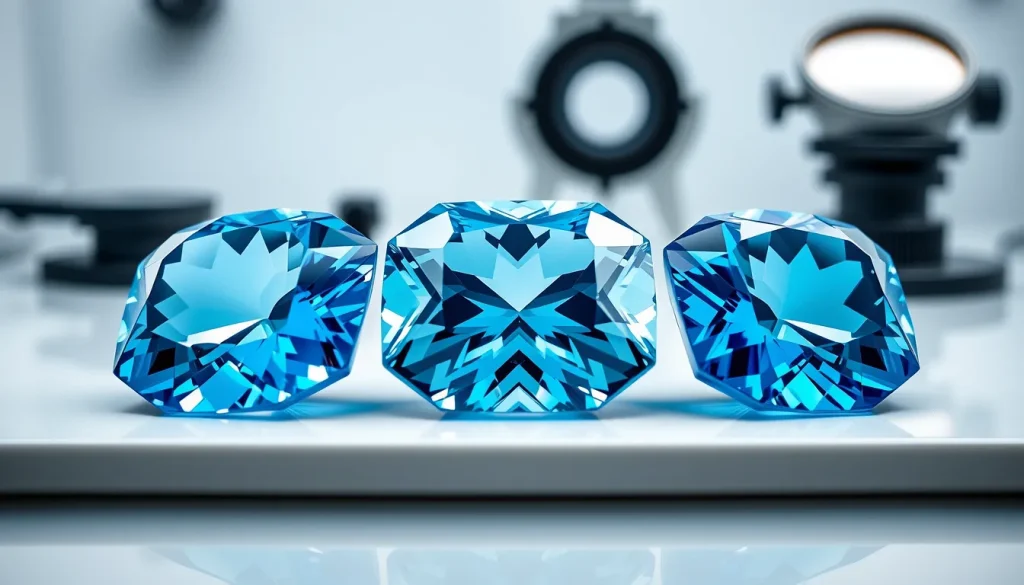
While naturally occurring blue topaz exists, it is exceedingly rare in the gemstone market. The vast majority of blue topaz jewelry encountered today is created from colorless or pale yellow topaz that has undergone specific laboratory treatments. These processes are widely accepted in the industry and are used to achieve consistent, commercially desirable hues.
What Is Blue Topaz?
Topaz is a fluorine hydroxide silicate mineral. In its pure form, it is colorless. However, due to its chemical structure, it is highly receptive to irradiation, a process that alters the crystal lattice to create color centers. When combined with controlled heating, these color centers can be shifted to produce a spectrum of blues, ranging from the pale brilliance of Sky Blue to the deep, moody tones of London Blue.
Treatments and Synthetic Counterparts
The transformation of colorless topaz into blue is a two-step scientific process involving radiation and thermal energy. Unlike synthetic gemstones, which are grown in a lab, treated blue topaz is natural topaz that has been enhanced.
The Irradiation Process
Irradiation involves exposing the gemstone to high-energy particles (usually gamma rays or electrons). This process displaces electrons within the crystal structure, creating “color centers” that absorb certain wavelengths of light and reflect blue. Without subsequent heating, irradiated topaz often appears a brownish-blue or greyish hue.
The Role of Heat Treatment
Heat treatment is used to “tune” the color produced by irradiation. By heating the stone to specific temperatures, gemologists can stabilize the color and shift the hue to meet trade standards. The duration and temperature of the heat determine the final variety:
- Sky Blue: Light irradiation followed by mild heating.
- Swiss Blue: Intense irradiation followed by specific heating to achieve a vivid, bright cyan.
- London Blue: Heavy irradiation followed by heating to create a deep, steely blue-green.
Expert Tip: While irradiation is permanent in most blue topaz, some very lightly treated stones may fade over decades if exposed to constant, intense UV light, though this is rare for modern commercial Swiss and London Blue varieties.
Identification and Look-Alikes
Distinguishing treated blue topaz from other blue gemstones requires a combination of visual inspection and gemological tools. Because the treatment is internal, it cannot be seen with the naked eye.
| Feature | Blue Topaz (Treated) | Aquamarine | Blue Zircon |
|---|---|---|---|
| Color | Vivid, consistent saturation | Pale to medium, often greenish | High dispersion (fire), deep blue |
| Hardness | 8 on Mohs Scale | 7.5 – 8 on Mohs Scale | 6.5 – 7.5 on Mohs Scale |
| Refractive Index | 1.61 – 1.64 | 1.57 – 1.58 | 1.92 – 1.98 |
Jewelry Suitability and Care
Blue topaz is an excellent choice for jewelry due to its high hardness and brilliance. However, the treatment process does not change the physical properties of the mineral, meaning it remains susceptible to cleavage.
- Cleaning: Use warm soapy water and a soft brush. Avoid ultrasonic cleaners if the stone has surface-reaching fractures.
- Chemicals: Avoid harsh chemicals or acids, which can damage the polish.
- Storage: Store separately from diamonds or sapphires to prevent scratching, despite its 8 Mohs hardness.
Quality and Value Factors
The value of treated blue topaz is primarily driven by color consistency and clarity. Because the raw material is often high-quality colorless topaz, most blue topaz is “eye-clean.” Value is generally higher for stones with a perfectly uniform hue across the entire crystal, free from “zoning” or uneven patches of color.
FAQ
Is treated blue topaz considered 'fake'?
No. It is a natural topaz mineral that has been enhanced. This is a standard industry practice and is not considered a synthetic or imitation stone.
Can the blue color fade over time?
While most treated blue topaz is stable, some very light Sky Blue stones may experience slight fading if exposed to extreme UV radiation for prolonged periods.
How can I tell the difference between Swiss Blue and London Blue?
Swiss Blue is a bright, vivid, 'electric' cyan blue. London Blue is much darker, with a deeper, steely blue-grey or greenish-blue tone.
Leave a Reply