
Short Answer
Definition
In gemology, Specific Gravity (SG) is a dimensionless quantity that represents the ratio of the density of a gemstone to the density of an equal volume of pure water at a specific temperature (typically 4°C). Essentially, it tells a gemologist how many times heavier a gemstone is compared to water. Because every mineral species has a characteristic chemical composition and crystalline structure, their specific gravities typically fall within a narrow, predictable range, making SG a critical diagnostic property for identification.
Plain-English Explanation
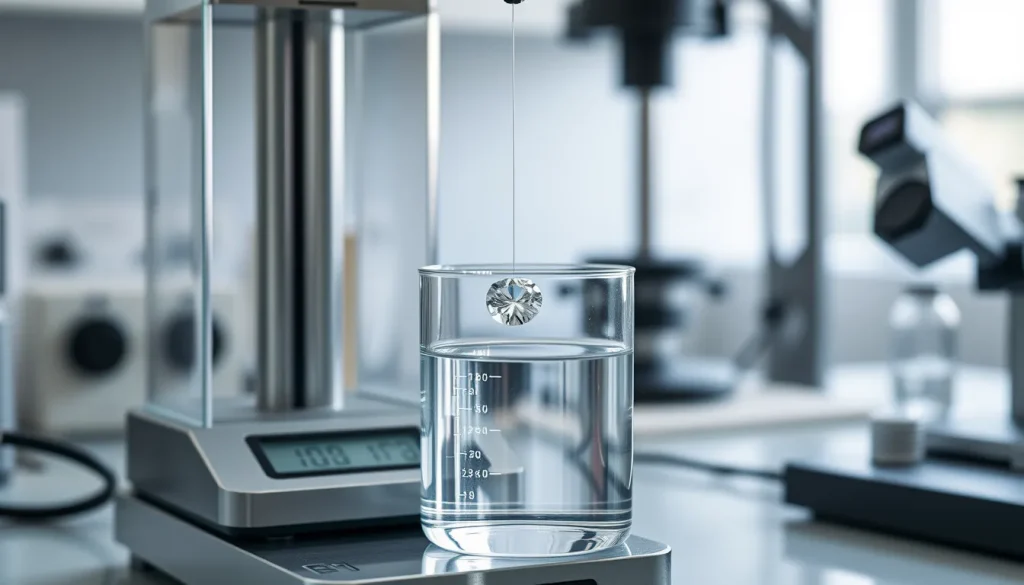
Imagine you have two stones that look identical—perhaps a natural diamond and a cubic zirconia. To the naked eye, they are both clear, sparkly, and hard. However, if you were to place them on a highly sensitive scale and then measure how much water they displace, you would find that the cubic zirconia feels significantly “heavier” for its size. This “heaviness” is what we call density. Specific gravity is simply the scientific way of measuring that density. If a gemstone has an SG of 3.52 (like a diamond), it means it is 3.52 times heavier than the same volume of water. If it has an SG of 2.65 (like quartz), it is 2.65 times heavier.
Example
Consider the challenge of distinguishing between a Natural Ruby and a Red Spinel. Both can be deep red and possess similar refractive indices. However, their specific gravities differ:
- Ruby (Corundum): SG approx. 3.98 – 4.06
- Red Spinel: SG approx. 3.60 – 3.62
By using a hydrostatic balance, a gemologist can determine the SG of the unknown stone. If the result is 4.0, it is almost certainly a ruby; if it is 3.6, it is likely a spinel. This difference, while seemingly small, is definitive when combined with other tests.
Expert Tip: Specific gravity is most useful when the gemstone is “clean” (free of large inclusions) and has a consistent composition. In porous stones or those with heavy inclusions, the SG reading may fluctuate slightly.
Why It Matters
Specific gravity is indispensable in the gemological laboratory for several reasons:
- Detection of Simulants: Many synthetic materials or “look-alikes” mimic the color and brilliance of precious stones but have vastly different densities.
- Narrowing Down Possibilities: When a stone is too small for some tests or too expensive to risk destructive testing, SG provides a non-destructive way to eliminate entire groups of minerals.
- Authentication of Rare Species: For rare minerals, SG acts as a “fingerprint” that helps confirm the identity of the specimen.
The following table illustrates the SG of common gemstones for quick reference:
| Gemstone | Specific Gravity (Approx.) |
|---|---|
| Diamond | 3.52 |
| Quartz | 2.65 |
| Sapphire/Ruby | 4.00 |
| Emerald | 2.72 |
| Topaz | 3.50 |
| Zircon | 4.60 – 4.70 |
FAQ
Can I measure specific gravity at home?
While the principle is simple, accurate SG measurement requires a professional hydrostatic balance and distilled water. Home scales are generally not sensitive enough to provide a useful result.
Does the size of the gemstone affect the SG?
No. Specific gravity is an intrinsic property of the material. Whether the stone is 1 carat or 100 carats, the SG remains the same for that specific mineral species.
Why is SG sometimes listed as a range instead of a single number?
Natural gemstones often contain trace elements or impurities that slightly alter their density, leading to a small range of acceptable values for a single species.
Leave a Reply