
Short Answer
Carbonate minerals represent a diverse and chemically distinct group of minerals characterized by the presence of the carbonate ion (CO3)2-. While often softer than the silicates that dominate the gemstone world, carbonates offer some of the most vibrant colors and unique crystal habits in the mineral kingdom, making them highly prized by collectors and lapidaries alike.
Definition
In mineralogy, a carbonate is a compound containing the carbonate ion, which consists of one carbon atom covalently bonded to three oxygen atoms. In the context of gemstones, these minerals typically form when carbonate-rich waters precipitate or through the alteration of other minerals. The general chemical formula for most common carbonate gemstones is M(CO3)n, where M represents a metal cation such as calcium, magnesium, copper, or manganese.
Plain-English Explanation
Think of carbonate minerals as the “chalky” family of the gemstone world. While diamonds are made of carbon in a tight, hard lattice, carbonates have carbon bonded with oxygen, creating a structure that is generally much softer and more reactive. A hallmark of this group is their reaction to acid; if you place a drop of dilute hydrochloric acid on most carbonates, they will effervesce (bubble), releasing carbon dioxide gas. This chemical quirk is a primary tool used by gemologists to distinguish them from look-alikes.
Example
The most prominent examples of carbonate minerals used as gemstones include:
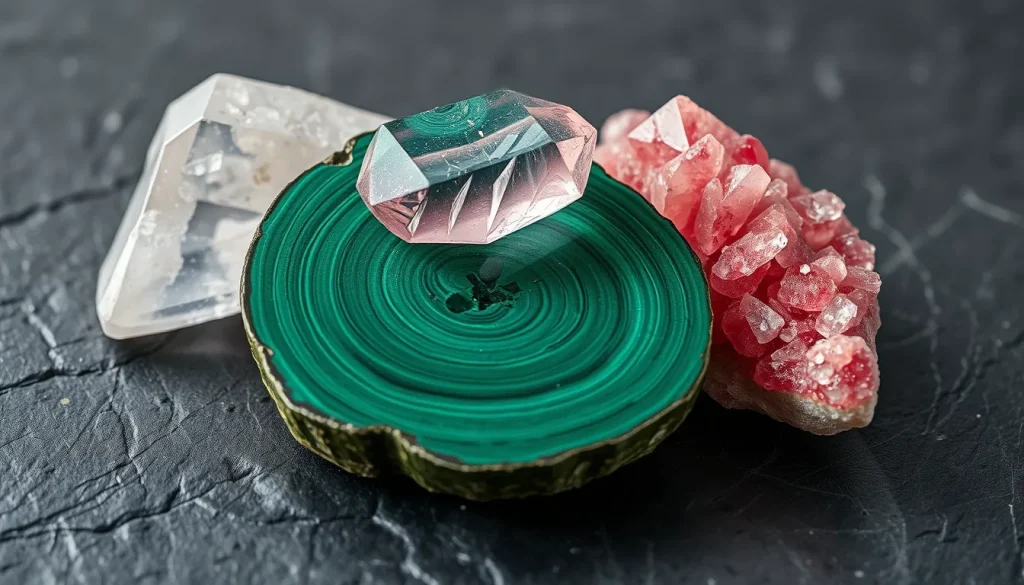
- Calcite: The most common carbonate, appearing in countless colors and forms, including the iridescent “Iceland Spar.”
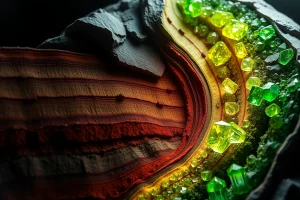
- Malachite: A vivid green copper carbonate known for its concentric banding.
- Rhodochrosite: A manganese carbonate prized for its striking raspberry-red to pink hues.
- Azurite: A deep blue copper carbonate often found in association with malachite.
Expert Tip: Because carbonate minerals are relatively soft (typically 3 to 4 on the Mohs scale), they are rarely used in rings. They are best suited for pendants or collector’s specimens to avoid surface scratching.
Why It Matters
Understanding carbonate chemistry is critical for three primary reasons:
- Durability and Care: Because they are soft and chemically reactive, carbonates cannot be cleaned with ultrasonic cleaners or acidic solutions (like lemon juice or vinegar), which would dissolve the stone’s surface.
- Identification: The specific gravity and the “acid test” allow gemologists to quickly separate carbonates from silicates or oxides that may share a similar color.
- Geological Context: Carbonates often indicate specific environmental conditions, such as ancient marine environments or hydrothermal vein deposits, providing clues about the gemstone’s origin.
FAQ
Can I wear malachite in a ring?
It is not recommended. Malachite is a carbonate with a Mohs hardness of 3.5-4, meaning it scratches easily. It is better suited for earrings or pendants.
How do I clean carbonate gemstones?
Use only a soft, damp cloth. Never use acidic cleaners, ultrasonic cleaners, or steam, as these can damage the surface or dissolve the mineral.
What is the difference between calcite and aragonite?
Both have the same chemical formula (CaCO3), but they have different crystal structures (polymorphs), which affects their hardness and cleavage.
Leave a Reply