
Short Answer
Comparison Table
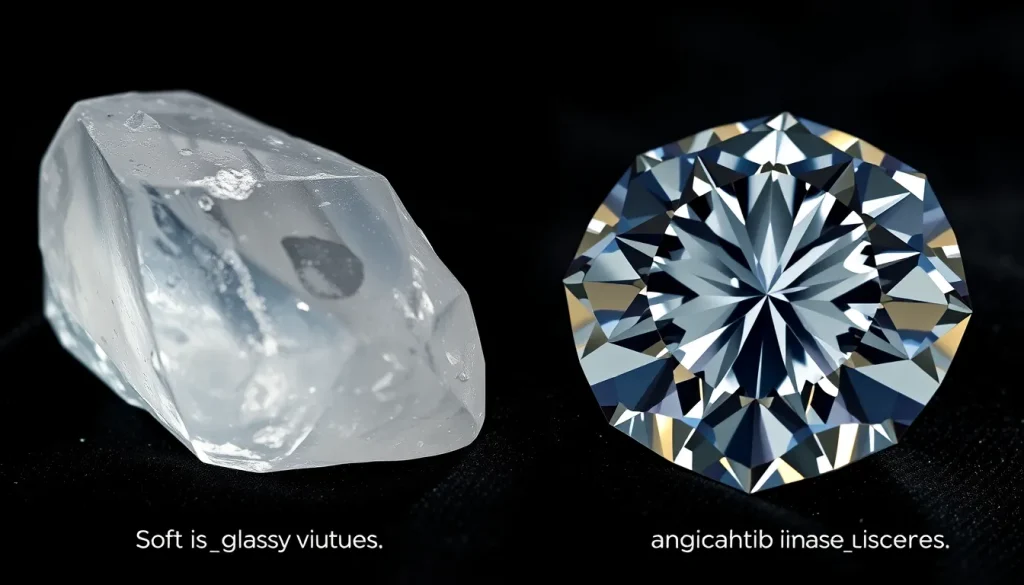
Luster refers to the way light interacts with the surface of a crystal. While both adamantine and vitreous lusters are categorized as ‘non-metallic,’ they differ significantly in intensity and the perceived ‘sharpness’ of the reflection.
| Feature | Vitreous Luster | Adamantine Luster |
|---|---|---|
| Visual Appearance | Glass-like, clear, bright | Diamond-like, intense, brilliant |
| Refractive Index (RI) | Typically Low to Moderate | Typically High (usually > 1.9) |
| Light Interaction | Smooth reflection | Sharp, high-contrast reflection |
| Common Examples | Quartz, Topaz, Tourmaline | Diamond, Zircon, Moissanite |
| Perceived Depth | Transparent clarity | Metallic-like brilliance |
Shared Features
Despite their differences in intensity, both adamantine and vitreous lusters share several core characteristics that distinguish them from other types of luster, such as pearly, silky, or resinous:
- Non-Metallic Nature: Neither luster exhibits the opaque, reflective quality of metals like gold or pyrite.
- Surface Dependence: Both require a smooth, polished surface to be fully realized; a rough crystal may mask these properties.
- Light Transmission: Both are typically associated with transparent to translucent gemstones, allowing light to enter the stone before being reflected.
Important Differences
The primary difference between the two lies in the Refractive Index (RI). The RI measures how much light bends as it enters a gemstone. The higher the RI, the more light is reflected from the surface, leading to a more intense luster.
The Vitreous Standard
Vitreous luster is the most common luster in the gemstone world. It is described as “glassy.” When you look at a piece of window glass or a clear quartz crystal, you are seeing vitreous luster. It is bright and clean, but it lacks the “fire” or extreme brilliance associated with high-RI stones.
The Adamantine Peak
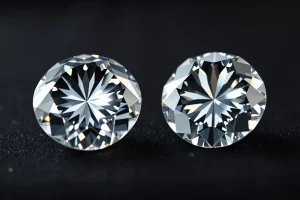
Derived from the Greek word adamas (meaning invincible), adamantine luster is the highest form of non-metallic luster. It is characterized by a brilliant, almost shimmering quality. This occurs because a higher percentage of light is reflected back to the eye rather than passing through the stone.
Expert Tip: To distinguish the two, observe the contrast between the light and dark areas on the gemstone’s facets. Adamantine stones show much sharper, more dramatic transitions.
Suitability by Use
The choice between a stone with vitreous or adamantine luster often depends on the desired aesthetic of the jewelry piece:
- Vitreous Stones: Preferred for designs where color saturation and transparency are the priority. For example, an Emerald’s vitreous luster allows the deep green hue to be the focal point without being overshadowed by surface glare.
- Adamantine Stones: Preferred for statement pieces and engagement rings where maximum brilliance and “sparkle” are desired. Diamonds and Zircons are chosen specifically for their ability to catch light from across a room.
Identification Limits
Identifying luster by eye alone can be deceptive due to several variables:
- Surface Polish: A poorly polished diamond may appear vitreous, while a highly polished quartz may seem more brilliant than it actually is.
- Lighting Conditions: Diffused light can mute adamantine luster, while direct spotlights can make vitreous stones appear more brilliant.
- Coatings: Some synthetic stones are coated with thin films to artificially enhance their surface reflection, mimicking an adamantine appearance.
Related Profiles
To further understand these concepts, researchers should examine the profiles of the following materials:
- Diamond: The gold standard for adamantine luster.
- Quartz: The quintessential example of vitreous luster.
- Zircon: A natural gemstone that bridges the gap with an exceptionally high RI and strong adamantine luster.
FAQ
Can a gemstone have both vitreous and adamantine luster?
No, a specific mineral species has one characteristic luster, though the quality of the polish and the specific variety can affect how that luster is perceived.
Does a higher luster mean a more expensive stone?
Not necessarily. While diamonds (adamantine) are expensive, some lower-value minerals also possess high luster, and some high-value stones like emeralds have a vitreous luster.
How can I test for luster at home?
While professional refractometers are best, you can compare a suspected stone against a piece of common glass. If the stone's reflection is significantly sharper and more intense than the glass, it may be adamantine.

Leave a Reply