
Short Answer
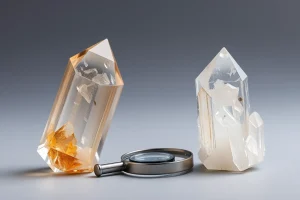
In the realm of mineralogy, one of the most captivating phenomena is polymorphism. Derived from the Greek words poly (many) and morphe (form), polymorphism occurs when a single chemical compound can crystallize in more than one distinct structural arrangement. For the gemstone collector, this means that two stones may share an identical chemical DNA yet possess entirely different physical properties, colors, and market values.
Definition
A mineral polymorph is a mineral that has the same chemical composition as another mineral but a different crystal structure. While the atoms are the same, the way those atoms are bonded and arranged in three-dimensional space differs. This structural variation is typically the result of the specific temperature and pressure conditions present during the mineral’s formation.
Plain-English Explanation
Imagine you have a set of LEGO bricks. If you use the exact same number and type of bricks to build a tall, thin tower, and then use that same set to build a flat, wide square, you have created two different structures from the same materials. In nature, minerals do this with atoms. Depending on whether the mineral formed deep in the Earth’s mantle (high pressure) or closer to the surface (low pressure), the atoms ‘lock’ into different patterns. Even though the ‘ingredients’ are the same, the resulting ‘cake’ looks, feels, and behaves differently.
Example
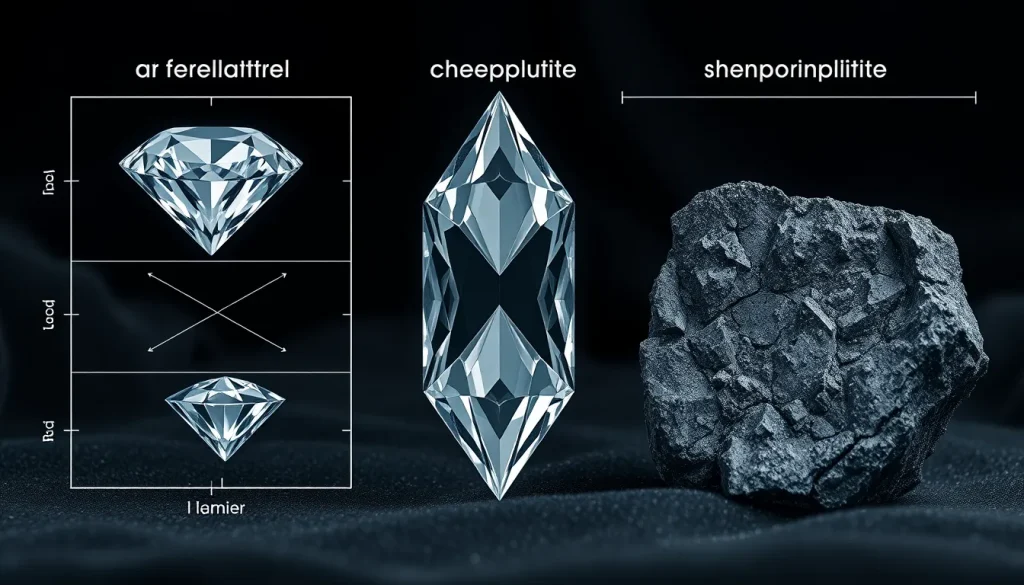
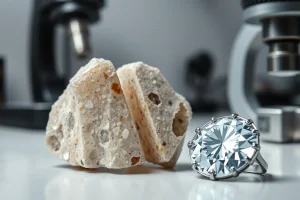
The most famous example of polymorphism in the gem world is the relationship between Diamond and Graphite. Both are composed of 100% pure carbon (C), yet they couldn’t be more different:
- Diamond: Formed under extreme pressure, carbon atoms bond in a rigid, tetrahedral lattice. This creates the hardest known natural substance, characterized by exceptional brilliance and transparency.
- Graphite: Formed under lower pressure, carbon atoms arrange themselves in hexagonal sheets that slide past one another. This results in a soft, opaque, grey-black mineral used in pencils.
Another notable example is the $ ext{Al}_2 ext{SiO}_5$ group, which includes Andalusite, Sillimanite, and Kyanite. Depending on the metamorphic conditions, this single chemical formula produces three distinct minerals with different hardness levels and crystal habits.
Why It Matters
For collectors and professionals, understanding polymorphism is critical for several reasons:
“Polymorphism reminds us that chemistry is only half the story; the environment of formation—the physics of the Earth—is what ultimately defines a gemstone’s identity.”
- Identification: Relying solely on chemical analysis (like XRF) can be misleading. A chemist might tell you a stone is pure carbon, but a gemologist using a refractometer or polariscope can tell you if it is a diamond or graphite.
- Value Assessment: As seen with diamond vs. graphite, the structural arrangement dictates the rarity and utility, and thus the price.
- Stability: Some polymorphs are unstable at surface conditions. Over millions of years, one polymorph may slowly transition into another (a process called inversion), which can affect the stone’s integrity.
FAQ
Can a polymorph change into another polymorph?
Yes, this is called a phase transition. For example, if a diamond is heated to extreme temperatures in the absence of pressure, it can theoretically revert to graphite.
Is a synthetic diamond a polymorph of graphite?
Yes. Whether natural or synthetic, any diamond is a polymorph of graphite because they share the same chemical composition (Carbon) but different structures.
How can I tell polymorphs apart if they have the same chemistry?
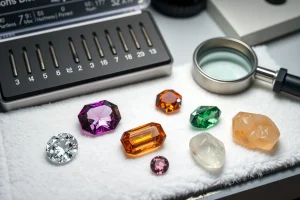
You must use physical tests. Hardness, refractive index, specific gravity, and crystal system are all different between polymorphs.
Leave a Reply