Short Answer
The Epidote group represents a complex series of calcium aluminum sorosilicate minerals. While often overlooked in mainstream jewelry due to their typically low transparency and specific color palette, they are of immense importance to geologists and mineral collectors. Characterized by their distinct crystal structures and prevalence in metamorphic rocks, these minerals provide critical insights into the pressure and temperature conditions of the Earth’s crust.
What Is Epidote?
Epidote is the namesake mineral of a group of sorosilicates, defined by the general chemical formula Ca2(Al2Fe3+)(SiO4)(Si2O7)O(OH). The term “sorosilicate” refers to the structure of the silicate tetrahedra, which occur in isolated pairs (double tetrahedra). This structural arrangement contributes to the mineral’s stability and its characteristic cleavage.
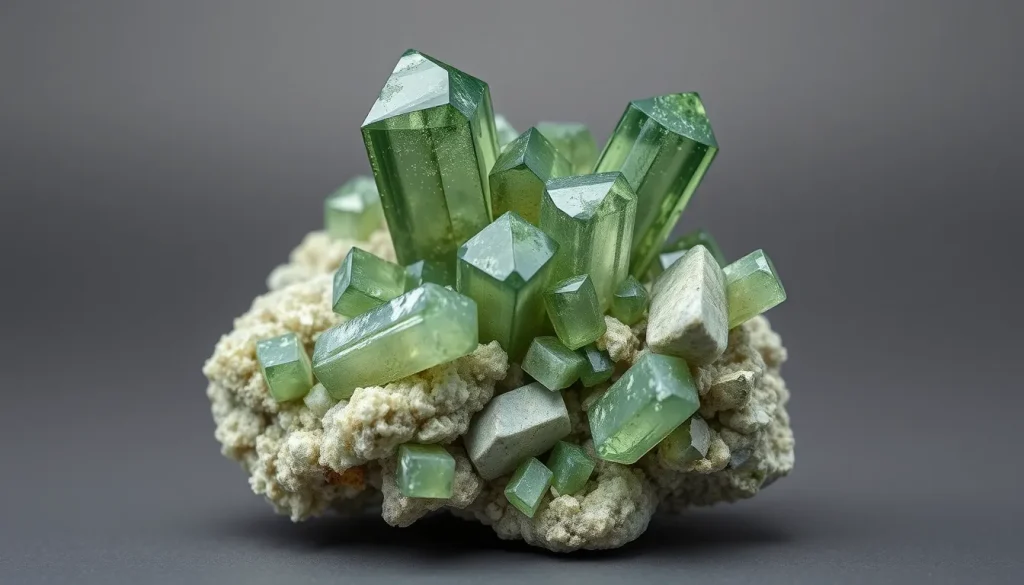
Visually, the most common form of epidote is a deep, pistachio-green to yellow-green color, though the group encompasses a wide range of hues depending on the iron and aluminum content. It typically occurs as prismatic crystals or massive aggregates and is frequently found in hydrothermal veins and metamorphic environments, such as greenschist facies.
Varieties and Related Materials
The Epidote group is not a single mineral but a solid-solution series. The most significant members include:

- Epidote: The iron-rich end member, typically exhibiting the classic green color.
- Clinozoisite: The aluminum-rich end member. It is often colorless or pale pink to grey and is less common in gemstone form but highly valued by collectors.
- Pistacite: A trade term used for the high-quality, translucent green varieties of epidote.
- Zoisite: While often discussed alongside epidote, zoisite is a closely related mineral. The two often occur together, and the presence of epidote inclusions in zoisite can create the sought-after “Anyolite” (ruby in zoisite) appearance.
Identification and Look-Alikes
Identifying Epidote group minerals requires a combination of visual inspection and physical testing. The most diagnostic feature is the characteristic pistachio-green color, which is rarely matched exactly by other minerals.
| Property | Epidote Value | Common Look-Alike (Diopside/Tourmaline) |
|---|---|---|
| Color | Pistachio Green | Forest Green to Emerald Green |
| Hardness | 6.5 – 7.0 | 5.5 – 6.5 (Diopside) / 7.0 – 7.5 (Tourmaline) |
| Luster | Vitreous to Resinous | Strongly Vitreous |
| Crystal Habit | Elongated Prismatic | Hexagonal/Trigonal (Tourmaline) |
Expert Tip: To distinguish Epidote from green Tourmaline, examine the crystal termination and the cleavage. Epidote exhibits a distinct monoclinic symmetry, whereas Tourmaline is trigonal. Under a microscope, the presence of tiny, needle-like inclusions is common in Epidote.
Jewelry Suitability and Care
Due to its moderate hardness (6.5–7), Epidote is suitable for jewelry, but with specific limitations. It is primarily used in cabochons or as polished specimen pieces rather than faceted gemstones, as high transparency is rare.
- Durability: Moderate. It can withstand daily wear in pendants or rings, but should be protected from hard impacts.
- Chemical Sensitivity: Epidote is generally stable, but it should be kept away from strong acids.
- Cleaning: Use lukewarm soapy water and a soft brush. Avoid ultrasonic cleaners if the specimen has visible fractures or is an aggregate of multiple minerals.
Quality and Value Factors
The value of Epidote group minerals is driven by three primary factors:
- Transparency: Transparent, gem-quality crystals command a significant premium over opaque, massive specimens.
- Color Saturation: A vivid, saturated green is more desirable than a pale or brownish-green hue.
- Crystal Integrity: Well-formed, undamaged prismatic crystals are highly prized by mineral collectors, often more so than polished stones.
FAQ
Is Epidote the same as Zoisite?
No, although they are closely related. Epidote is a sorosilicate, while Zoisite is an inosilicate. They often occur together in the same geological environments.
Can Epidote be used in rings?
Yes, with a hardness of 6.5-7, it is durable enough for rings, though cabochon cuts are recommended over facets due to the mineral's typical opacity.
How can I tell Epidote apart from Peridot?
Peridot is typically a brighter, more 'electric' lime green and is an olivine (nesosilicate). Epidote has a more muted, 'pistachio' green and different crystal symmetry.
Leave a Reply