
Short Answer
Definition
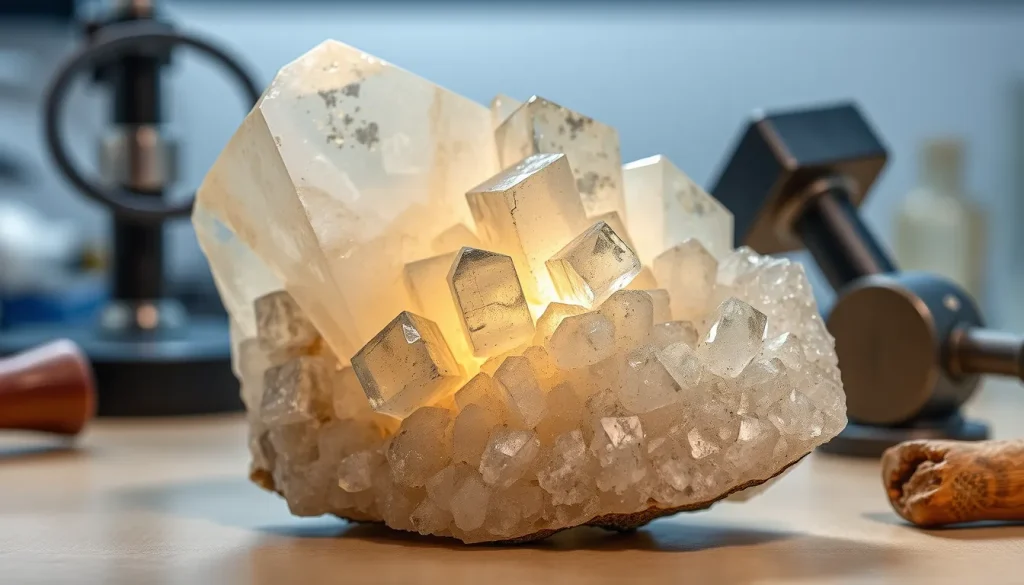
Basal cleavage is a specific type of mineral cleavage where the crystal breaks along a single, well-defined plane that is parallel to the base of the crystal. In gemological terms, it represents a direction of structural weakness within the atomic lattice of the gemstone. When a force is applied, the mineral tends to split along this specific plane rather than fracturing irregularly.
Plain-English Explanation
Imagine a gemstone as a stack of very thin sheets of paper glued together. While the paper is strong if you try to pull it from the sides, it is very easy to peel the sheets apart or slice through the stack horizontally. Basal cleavage is exactly like that: the gemstone has one primary “layer” or “plane” where the chemical bonds are significantly weaker than in other directions. If the stone is hit or pressured correctly, it will split perfectly flat along that layer, often resulting in a smooth, mirror-like surface.
Example
The most classic example of basal cleavage is found in Mica, though in the realm of precious gemstones, certain varieties of Kyanite or Graphite exhibit this behavior. In Kyanite, the cleavage is so distinct that the stone’s hardness actually changes depending on whether you are measuring parallel or perpendicular to the cleavage plane. Another notable example is Biotite, which can be peeled into incredibly thin, flexible sheets because of its perfect basal cleavage.
“For a lapidary, recognizing basal cleavage is the difference between a successful facet and a shattered stone. One wrong angle on the grinding wheel can trigger a cleavage split that ruins the entire specimen.” — Senior Gemologist Note
Why It Matters
Understanding basal cleavage is paramount for three primary reasons: stability, value, and craftsmanship.
- Risk of Fracture: Gemstones with perfect basal cleavage are more susceptible to “cleaving”—splitting wide open—if they are struck by a hard object or subjected to thermal shock. This makes them riskier for use in rings, where they are prone to impacts.
- Lapidary Precision: When cutting a stone, the gem cutter (lapidary) must orient the facets to avoid putting pressure directly against the cleavage plane. If the orientation is ignored, the stone may split during the polishing process.
- Identification: Gemologists use the presence and direction of cleavage to distinguish between similar-looking minerals. For instance, the way a mineral splits can help differentiate a true gemstone from a synthetic or a different mineral species with similar color and refractive index.
FAQ
Is cleavage the same as a fracture?
No. Cleavage is a break along a specific plane of atomic weakness, resulting in a flat surface. A fracture is an irregular break that occurs when the mineral lacks a dominant cleavage plane.
Can a gemstone have more than one cleavage plane?
Yes. While basal cleavage is a single plane, other minerals have prismatic cleavage (two planes) or cubic cleavage (three planes at 90 degrees), such as Halite.
Does basal cleavage make a gemstone less valuable?
Not necessarily, but it affects the 'utility' value. A stone with high cleavage risk may be less desirable for a ring but perfectly fine for a pendant or a collector's specimen.
Leave a Reply