
Short Answer
Sapphire, a variety of the mineral corundum, is prized for its hardness and vivid colors. However, the rise of sophisticated laboratory processes—such as the Verneuil (flame fusion), Czochralski, and hydrothermal methods—has made it increasingly difficult for the untrained eye to distinguish between natural and synthetic stones. While synthetic sapphires are chemically and physically identical to natural ones, they possess distinct growth signatures that reveal their origin.
Direct Answer
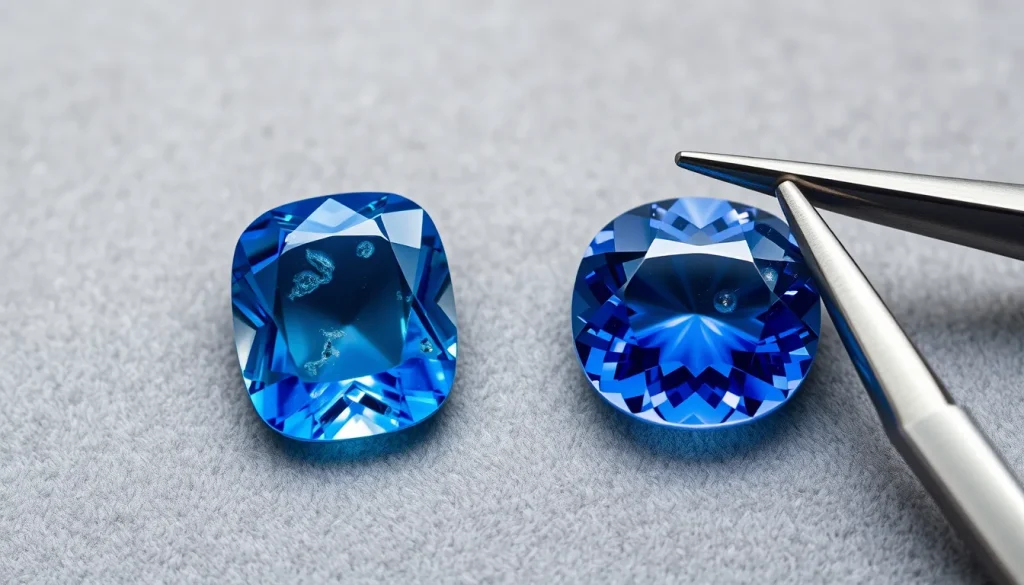
The primary way to identify a natural sapphire from a synthetic one is by examining the internal inclusions and growth structures using a gemological microscope. Natural sapphires typically contain “fingerprints,” mineral crystals, and irregular silk (rutile needles), whereas synthetic sapphires often exhibit curved striae, gas bubbles, or an unnatural lack of any inclusions (eye-cleanliness). While basic tests like hardness or refractive index are identical for both, the presence of natural mineral crystals is the most reliable indicator of an earth-mined origin.
Relevant Conditions
Identification becomes complex depending on the method of synthesis used. A buyer should be aware of the following conditions when evaluating a sapphire:
- Flame Fusion (Verneuil): The most common synthetic. Often shows curved growth lines (striae) and tiny gas bubbles.
- Hydrothermal: These are high-quality synthetics that mimic natural growth more closely, often showing “chevron” shaped growth patterns.
- Flux-Grown: These can be very deceptive as they may contain “fingerprint” inclusions similar to natural stones, though they often contain flux remnants.
- Treated Naturals: Many natural sapphires are heat-treated or diffusion-treated. These are still natural but have altered properties, which can sometimes be mistaken for synthetic characteristics.
Recommended Steps
To systematically evaluate a sapphire, follow these professional observation steps:

- Visual Inspection (10x Loupe): Look for “too perfect” clarity. A completely flawless, vivid blue sapphire is a red flag for a synthetic origin.
- Microscopic Analysis:
- Search for curved striae: If you see curved lines of color or growth, it is almost certainly a flame-fusion synthetic.
- Search for angular crystals: The presence of small, distinct crystals of other minerals (like zircon or apatite) inside the sapphire strongly suggests a natural origin.
- Check for bubbles: Small, spherical gas bubbles are a definitive sign of synthetic production.
- Polariscope Examination: Use a polariscope to check for optic properties. While both are uniaxial, certain synthetic growth patterns may show abnormal extinction.
- Spectroscopic Analysis: For high-value stones, a gemologist will use an FTIR (Fourier Transform Infrared) spectrometer to detect chemical signatures unique to lab-grown processes.
Expert Tip: Never rely on a “bubble test” or “scratch test” alone. Because sapphires are incredibly hard (9 on the Mohs scale), they are resistant to most scratches, and some natural sapphires can contain fluid inclusions that look like bubbles to the untrained eye.
Exceptions
There are several scenarios where standard identification rules may lead to confusion:
- High-Quality Natural Sapphires: Some rare, high-grade natural sapphires are virtually inclusion-free, which can lead a novice to believe they are synthetic.
- Diffusion-Treated Stones: These are natural sapphires where chemicals (like beryllium) have been diffused into the surface to improve color. These may show “color zoning” that looks synthetic.
- Advanced Hydrothermal Synthetics: These stones lack the obvious curved striae of flame-fusion stones and require professional laboratory equipment to identify.
When to Ask a Professional
Given the financial stakes involved in sapphire purchasing, professional certification is mandatory in the following cases:
- High Investment Value: When the stone is marketed as “investment grade” or “rare.”
- Conflicting Documentation: If the seller’s claims do not align with your visual observations.
- Lack of Certification: Any stone sold without a report from a recognized laboratory (e.g., GIA, SSEF, or Gübelin).
- Unusual Color: If the color is an unnaturally saturated “electric blue” that appears uniform throughout the stone.
FAQ
Are synthetic sapphires fake?
No, they are not 'fake' in the sense of being glass or plastic; they are chemically, physically, and optically identical to natural sapphires, but they are grown in a lab rather than the earth.
Can a diamond tester identify synthetic sapphires?
No. Diamond testers measure thermal or electrical conductivity, which does not distinguish between natural and synthetic corundum.
Why are natural sapphires more expensive than synthetic ones?
Natural sapphires are finite resources created over millions of years under extreme geological conditions, making them significantly rarer than lab-grown versions.
Leave a Reply