
Short Answer
Direct Answer
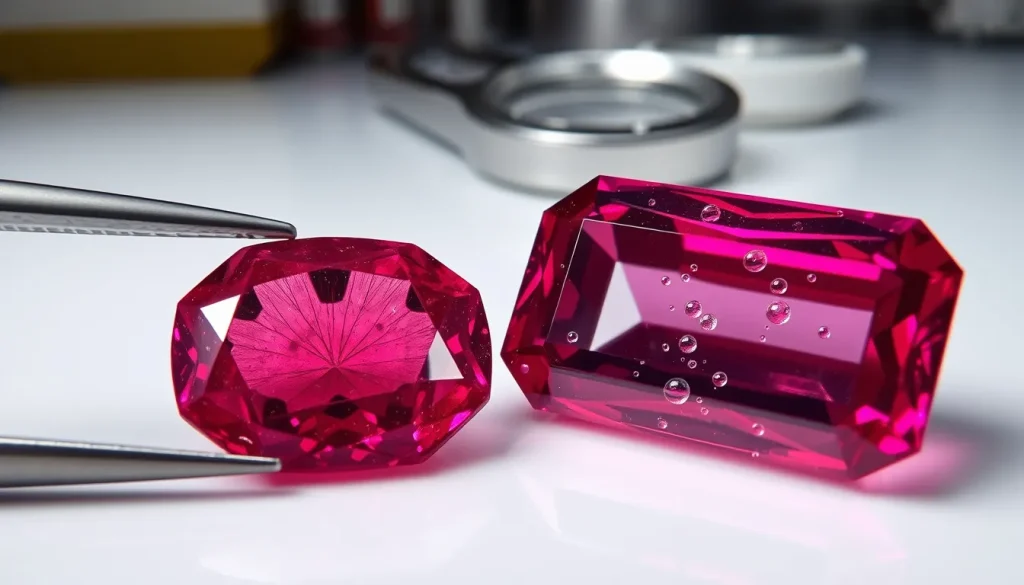
Identifying natural versus synthetic corundum (rubies and sapphires) involves analyzing the internal crystal structure and inclusions. While synthetic corundum is chemically and physically identical to natural corundum, it lacks the geological “fingerprints”—such as mineral crystals and liquid-gas bubbles—found in natural stones. The most definitive identification is achieved through microscopic examination to look for curved striae (growth lines) and the absence of natural mineral inclusions.
Relevant Conditions
Identification is necessary because the market value of natural corundum is exponentially higher than that of synthetic equivalents. Several conditions make identification challenging:
- Flame Fusion (Verneuil) Method: The most common synthetic; often exhibits curved growth lines.
- Flux Growth: These synthetics mimic natural crystals more closely and can be very difficult to distinguish without advanced equipment.
- Czochralski Process: Produces high-purity crystals often used in industrial applications or high-end jewelry.
- Treatment Overlap: Natural stones that have been heat-treated or glass-filled can sometimes exhibit features that confuse a novice observer.
Recommended Steps
To accurately identify the origin of a corundum specimen, follow these professional gemological steps:
- Visual Inspection: Check for “too perfect” color and clarity. Natural rubies and sapphires rarely possess flawless transparency and uniform saturation across the entire stone.
- Microscopic Analysis: Use a 10x loupe or a gemological microscope to inspect the interior.
- Look for Curved Striae: Curved growth lines are a hallmark of Flame Fusion synthetics.
- Search for “Silk”: Fine needles of rutile are common in natural corundum.
- Identify Bubbles: Small, spherical gas bubbles are a strong indicator of synthetic origin.
- Refractive Index (RI) Testing: While both have an RI of approximately 1.762–1.770, checking for pleochroism (color change when viewed from different angles) can help confirm the species.
- Spectroscopic Analysis: Use a spectroscope to identify absorption lines. Certain synthetic processes leave trace chemical signatures that differ from natural geological deposits.
- High-Quality Flux-Grown Synthetics: These may contain “fingerprint” inclusions that look natural, requiring advanced FTIR (Fourier Transform Infrared) spectroscopy to confirm.
- Hydrothermal Synthetics: These are grown in high-pressure autoclaves and can exhibit angular growth patterns similar to natural stones.
- Natural “Flawless” Stones: Extremely rare, high-grade natural stones may lack obvious inclusions, making them look synthetic to the untrained eye.
- High-Value Transactions: Whenever a stone is marketed as “Investment Grade” or “Natural.”
- Conflict of Indicators: When a stone shows both natural-looking inclusions and synthetic-looking growth lines.
- Certification Requirements: When a legal or insurance document requires a laboratory report from an accredited body like the GIA or SSEF.
- Advanced Treatment Suspicions: When you suspect the stone has undergone beryllium diffusion or lead-glass filling, which can mask the stone’s true origin.
Expert Tip: Always look for “zoning.” Natural corundum often shows angular growth zoning, whereas synthetic corundum may show curved or no zoning at all.
Exceptions
There are rare cases where standard tests may be misleading:
When to Ask a Professional
Given the high stakes of corundum valuation, professional consultation is mandatory in the following scenarios:
FAQ
Can a diamond tester identify synthetic corundum?
No. Diamond testers measure thermal or electrical conductivity; they cannot distinguish between natural and synthetic corundum.
Are synthetic rubies 'fake'?
No, they are not 'fake' in the sense of being stimulants (like cubic zirconia). They are chemically and physically identical to natural rubies, but they are man-made.

Does a lack of inclusions always mean a stone is synthetic?
Not necessarily, but it is a strong red flag. While rare natural stones can be clean, most natural corundum contains some geological evidence of its formation.
Leave a Reply