Short Answer
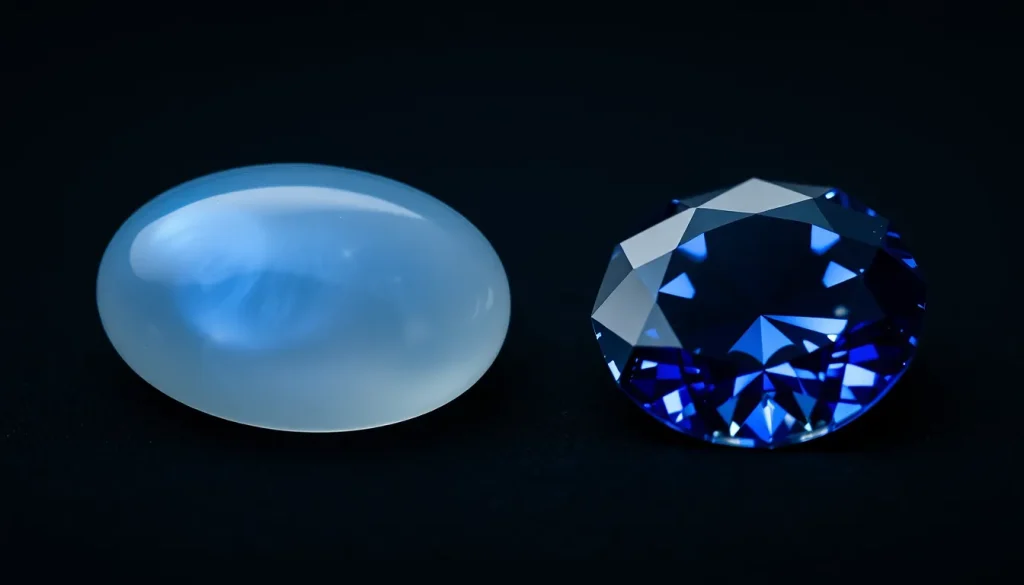
In the world of lapidary arts, the method used to shape a raw mineral into a finished gemstone is critical. The choice between a cabochon and a faceted cut is rarely arbitrary; it is a decision driven by the gemstone’s optical properties, internal clarity, and the desired visual effect. While faceting aims to maximize brilliance and fire, the cabochon cut emphasizes color, pattern, and luster.
Comparison Table
| Feature | Cabochon Cut | Faceted Cut |
|---|---|---|
| Shape | Smooth, rounded dome with a flat base | Flat geometric surfaces (facets) |
| Primary Goal | Showcase color, opacity, or phenomena | Maximize light return, brilliance, and fire |
Light Interaction
| Reflects light off the surface (luster) | Refracts light through the stone (scintillation) |
| Ideal Clarity | Opaque, translucent, or heavily included | Transparent to semi-transparent |
| Common Examples | Opal, Turquoise, Star Sapphire | Diamond, Ruby, Emerald |
| Durability | Generally more resistant to chipping | Edges/points are more prone to chipping |
Shared Features
Despite their visual differences, both cabochon and faceted cuts share a common purpose: to enhance the natural beauty of a mineral and make it suitable for jewelry settings. Both processes require lapidary equipment, such as grinding wheels and polishing compounds, and both must account for the gemstone’s hardness (Mohs scale) to prevent cracking during the cutting process. Furthermore, both styles aim to remove unsightly surface flaws and inclusions to increase the overall market value of the specimen.
Important Differences
The fundamental difference lies in how light interacts with the material. A faceted cut is engineered to act as a series of mirrors. By cutting precise angles, the lapidary ensures that light enters the crown, reflects off the pavilion facets, and returns to the eye of the observer. This creates brilliance (white light return) and fire (dispersion of light into spectral colors).
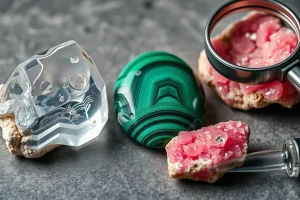
Conversely, a cabochon (from the French caboche, meaning bugle) is polished into a smooth, convex shape. This style is preferred for gemstones that are too opaque for light to pass through, or for those that exhibit optical phenomena. For example, the “star” in a star sapphire or the “eye” in a cat’s eye chrysoberyl is only visible in a cabochon cut; faceting would destroy these effects by breaking up the aligned needle-like inclusions.
Gemologist’s Tip: When choosing a cut for an opaque stone like Turquoise or Lapis Lazuli, always opt for a cabochon. Faceting an opaque stone results in a “dead” appearance, as there is no internal light to reflect.
Suitability by Use
The choice of cut is often dictated by the specific mineral’s characteristics:
- Transparent Gems: For stones like Diamonds, Sapphires, and Topaz, faceting is the gold standard to highlight their transparency and refractive index.
- Phenomenal Gems: Stones exhibiting adularescence (Moonstone), opalescence (Opal), or asterism (Star Ruby) must be cut as cabochons to preserve the effect.
- Opaque Gems: Materials like Jasper, Agate, and Turquoise are exclusively cut as cabochons to showcase their saturated colors and patterns.
- Low-Durability Gems: For softer stones, a cabochon is often safer because it lacks the sharp edges of facets that can easily chip or wear down.
Identification Limits
Cutting styles can sometimes obscure the identity of a gemstone, making professional identification necessary. For instance, a high-quality synthetic spinel faceted to look like a ruby can be deceptive to the untrained eye. Similarly, some cabochons are treated with resins or dyes to hide cracks, which are less visible under a smooth dome than they would be through the windows of a faceted stone. A gemologist uses a refractometer and microscope to identify the stone regardless of its cut, as the physical properties of the mineral remain constant.
Related Profiles
To further understand how cutting affects value, collectors should study the profiles of Corundum (where both cuts are common depending on transparency) and Opal (where the cabochon is nearly universal). Understanding the Refractive Index (RI) of a mineral is also essential, as it determines whether a faceted cut will actually produce the desired brilliance or if the stone will appear “dark” in the center.
FAQ
Can a cabochon be turned into a faceted stone?
Yes, but it requires removing a significant amount of material. This is only recommended if the stone is transparent and the value increase from faceting outweighs the loss of carat weight.
Why are opals almost always cabochons?
Opals are prized for their 'play-of-color.' Faceting an opal would break up the light paths and diminish the vivid flashes of color that make the stone valuable.
Which cut is more expensive?
Neither cut is inherently more expensive; the value depends on the rarity of the mineral and the skill of the cutter. However, faceted stones often require higher clarity, which can make the raw material more expensive.
Leave a Reply