
Short Answer
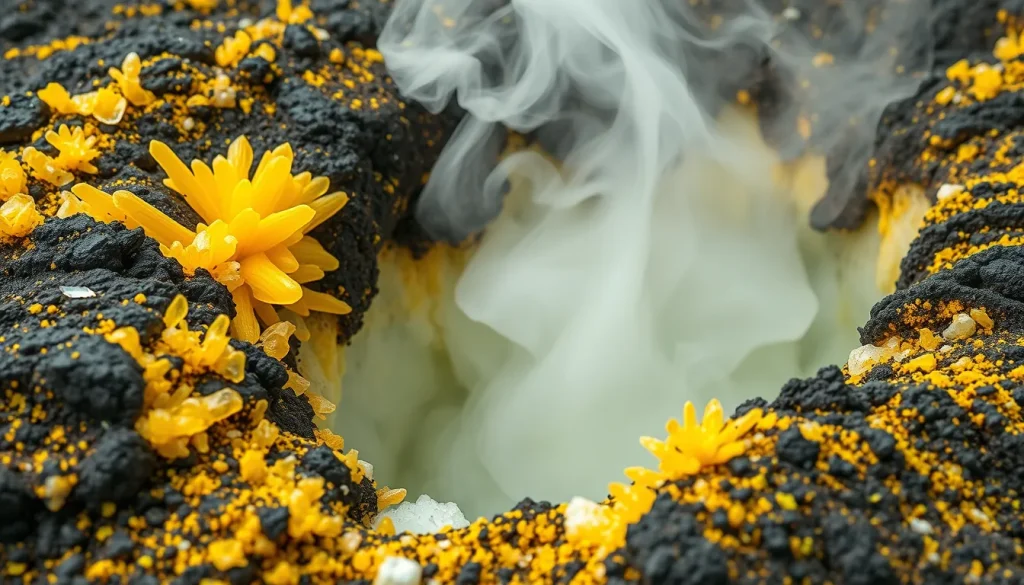
In the violent intersection of subterranean heat and atmospheric cooling, a rare class of mineralogy emerges. Fumarolic minerals are not formed from cooling magma or slow-moving hydrothermal fluids, but rather from the direct transition of volcanic gases into solid crystals. This process, known as sublimation, creates some of the most chemically fragile and visually striking specimens in the mineral kingdom.
Definition
Fumarolic minerals are minerals that precipitate directly from the gaseous phase (sublimation) or from highly concentrated vapors escaping through fumaroles—openings in the Earth’s crust, typically found near volcanoes, geysers, or hydrothermal vents. Unlike most gemstones that crystallize from a liquid melt or an aqueous solution, fumarolic minerals are the result of rapid cooling and chemical deposition of sulfurous, halogen, and metallic gases.
Plain-English Explanation
Imagine a volcanic vent as a giant chemical steamer. Deep underground, intense heat vaporizes elements like sulfur, arsenic, and antimony. As these hot gases rise and hit the cooler air at the surface, they don’t just turn into liquid water; they “freeze” instantly into solid crystals. This is similar to how frost forms on a windowpane during winter, but instead of water vapor becoming ice, volcanic gases become vivid crystals of sulfur or rare halides. These minerals often grow in delicate, needle-like or crust-like formations around the mouth of the vent.
Example
The most iconic example of a fumarolic mineral is Native Sulfur. In regions like the Ijen volcano in Indonesia or the volcanic fields of Sicily, bright yellow sulfur crystals bloom around the vents. Other more exotic examples include:

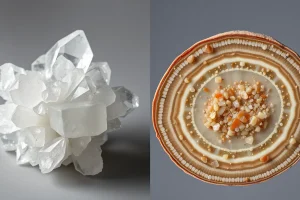
- Sal ammoniac (Ammonium Chloride): A white, salty mineral often found in the cooler peripheries of fumaroles.
- Realgar and Orpiment: Vivid red and yellow arsenic sulfides that can form through the sublimation of arsenic-rich gases.
- Tennantite/Bornite: Certain copper-based minerals that can precipitate in high-temperature volcanic gas environments.
Gemologist’s Note: Because many fumarolic minerals are formed at low pressures and are chemically volatile, they are often extremely soft and sensitive to heat or light, making them “collector’s gems” rather than jewelry-grade stones.
Why It Matters
Fumarolic minerals are critical to both geology and gemology for several reasons:
- Chemical Indicators: The presence of specific fumarolic minerals tells scientists exactly what is happening inside a volcano. For instance, a shift from sulfur to halide minerals can indicate a change in the magma’s composition or the depth of the hydrothermal system.
- Rarity and Aesthetics: Because they require very specific temperature gradients to form, they are found in only a few locations worldwide, making them highly prized by mineral collectors.
- Study of Sublimation: They provide a natural laboratory for studying how elements transition from gas to solid, a process that also occurs in the atmospheres of other planets and moons in our solar system.
FAQ
Can fumarolic minerals be used in jewelry?
Generally, no. Most fumarolic minerals (like sulfur or ammonium chloride) are too soft, fragile, or chemically unstable to withstand the pressures of jewelry setting or daily wear.
Are they different from igneous rocks?
Yes. Igneous rocks form from the cooling of molten magma (liquid). Fumarolic minerals form from the cooling of volcanic gases (vapor).
Where can I find these minerals?
They are found near active or dormant volcanoes, such as those in Iceland, Italy (Sicily), Indonesia, and the Andes.
Leave a Reply