
Short Answer
Direct Answer
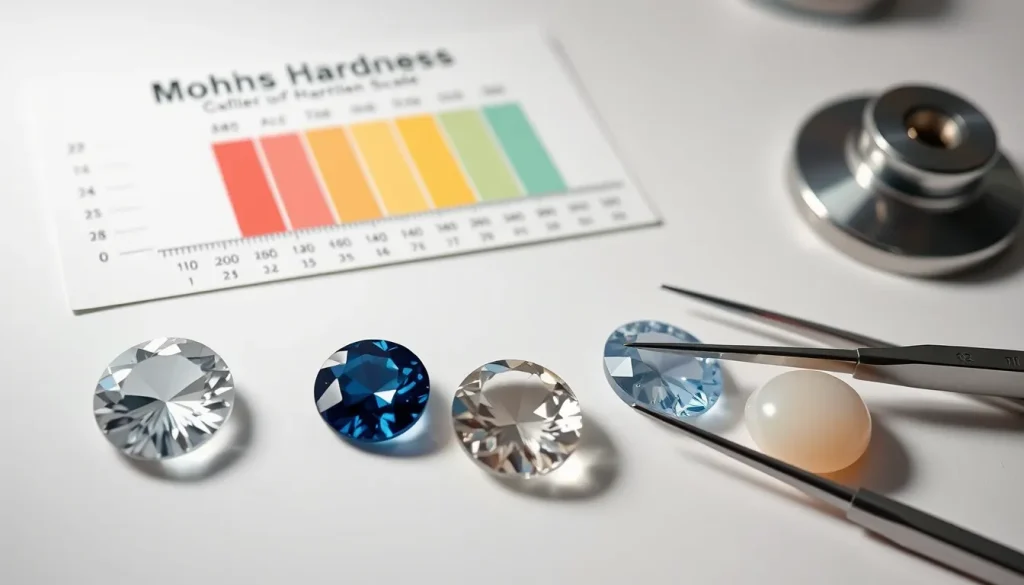
The Mohs scale of mineral hardness is a qualitative ordinal scale used to characterize the scratch resistance of various minerals. In the context of jewelry, it serves as the primary benchmark for determining whether a gemstone is durable enough for a specific piece of jewelry. For example, a gemstone with a high Mohs rating (like a diamond at 10) is highly resistant to surface scratches, making it ideal for engagement rings, whereas a stone with a low rating (like opal at 5.5–6.5) is better suited for earrings or pendants where it is less likely to encounter abrasive contact.
Relevant Conditions
When selecting a gemstone, hardness is not the only factor to consider, but it is the most critical for long-term wear. Different jewelry types expose stones to different levels of stress:
- High-Impact Areas: Rings (especially engagement rings) are subject to constant contact with hard surfaces, increasing the risk of scratches and chips.
- Low-Impact Areas: Earrings and necklaces generally protect the gemstone from abrasive contact, allowing for the use of softer minerals.
- Environmental Exposure: Gemstones exposed to household chemicals, perfumes, or extreme temperature changes may degrade faster, regardless of their Mohs rating.
Expert Tip: Do not confuse hardness with toughness. Hardness refers to the resistance to scratching, while toughness refers to the resistance to fracturing or chipping. A diamond is the hardest mineral, but it can still be shattered by a sharp blow due to its cleavage planes.
Recommended Steps
To choose a gemstone based on durability, follow these professional guidelines:
- Identify the Jewelry Type: Determine if the stone will be in a high-wear (ring) or low-wear (earrings) setting.
- Consult the Mohs Rating: Use the following general durability tiers:
- Excellent (9-10): Diamond, Corundum (Sapphire/Ruby). Ideal for any jewelry.
- Good (7-8): Topaz, Quartz, Spinel, Garnet. Suitable for most rings with reasonable care.
- Fair (6-7): Peridot, Tanzanite, Tourmaline. Best for earrings, pendants, or rings worn occasionally.
- Fragile (Below 6): Opal, Turquoise, Pearls. Strictly for low-impact jewelry or collector pieces.
- Evaluate the Setting: If choosing a softer stone for a ring, opt for a bezel setting rather than a prong setting to provide more physical protection to the edges of the stone.
- Check for Cleavage: Research if the mineral has prominent cleavage planes (like Kyanite), which may make it prone to splitting even if the Mohs rating is moderately high.
Exceptions
There are several instances where the Mohs scale can be misleading if used in isolation:

- The Non-Linear Nature of the Scale: The Mohs scale is not linear. For instance, a diamond (10) is significantly harder than a corundum (9)—roughly four times harder—whereas the difference between a 7 and an 8 is much smaller.
- Toughness vs. Hardness: Some stones are hard but brittle. For example, some varieties of Zircon have a high Mohs rating but can chip easily due to internal stresses.
- Composite Materials: Organic gems like pearls or amber do not follow the same crystalline structure as minerals and require specialized care regardless of their relative hardness.
When to Ask a Professional
While the Mohs scale provides a general guide, you should consult a certified gemologist in the following scenarios:
- Investment Purchases: When buying high-value stones, a professional can identify internal inclusions or feathers that might compromise the structural integrity of the gem.
- Custom Settings: If you wish to set a soft stone in a ring, a jeweler can advise on the safest mounting techniques to prevent loss or damage.
- Identification of Unknown Stones: Never attempt to test hardness by scratching a gemstone yourself, as this can permanently damage the stone. A professional uses non-destructive testing methods.
FAQ
Can a diamond be scratched by anything?
Yes, a diamond can only be scratched by another diamond or a material of equal or greater hardness.
Is a gemstone with a Mohs rating of 7 safe for an engagement ring?
Generally yes, but it requires more care than a sapphire or diamond. It is suitable for most users, provided they avoid abrasive environments.
Why did my 'hard' gemstone chip?
This is likely due to low toughness or the presence of cleavage planes. Hardness only measures scratch resistance, not resistance to impact.
Leave a Reply