
Short Answer
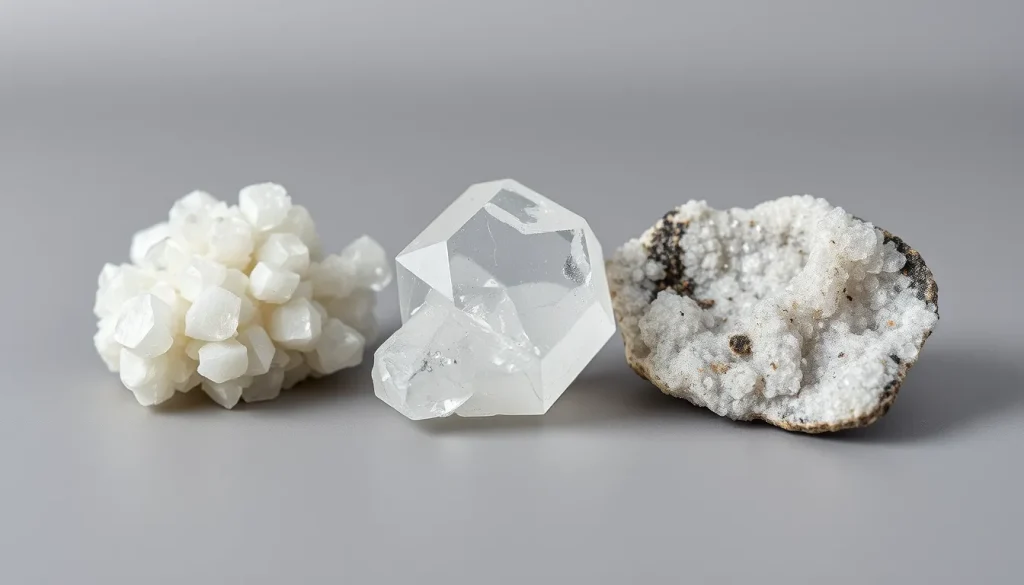
Borate minerals are a diverse group of chemical compounds containing boron, typically occurring as evaporites in arid regions. While rarely used in high-end jewelry due to their relative softness, they are highly prized by mineral collectors for their unique crystal habits and extraordinary optical properties. This guide provides a comparative analysis of three primary borates: Colemanite, Boracite, and Ulexite.
Comparison Table
| Property | Colemanite | Boracite | Ulexite |
|---|---|---|---|
| Chemical Formula | Ca2B6O11·5H2O | Mg3B7O13Cl | NaCaB5O6(OH)6·5H2O |
| Mohs Hardness | 3.5 | 5.0 | 2.0 – 2.5 |
| Crystal System | Triclinic | Isometric | Triclinic (Fibrous) |
| Typical Color | Colorless, White | Colorless, Yellow, Green | White, Colorless |
| Key Feature | High Boron Content | High Hardness | TV-Stone (Fiber Optics) |
Shared Features
Despite their different physical appearances, Colemanite, Boracite, and Ulexite share several fundamental characteristics:
- Chemical Origin: All three are borates, forming primarily from the evaporation of boron-rich waters in closed basins or volcanic environments.
- Solubility: Most borates exhibit varying degrees of solubility in water, which makes them unstable for jewelry that requires frequent cleaning.
- Industrial Value: They serve as primary sources of boron for the production of glass, ceramics, and detergents.
Important Differences
The primary distinctions between these minerals lie in their structural integrity and optical behavior.
The Optical Wonder of Ulexite
Ulexite is distinct for its fibrous habit. These fibers act as natural fiber-optic cables, transmitting light along the length of the crystal. This creates the “TV-stone” effect, where an image placed beneath a polished slab of Ulexite is projected clearly to the surface.
The Durability of Boracite
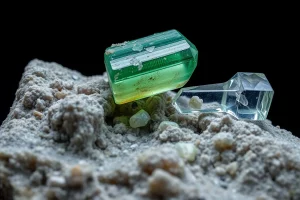
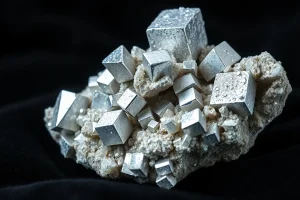
Unlike most borates, Boracite is relatively hard (Mohs 5), making it the most durable of the three. It often forms well-defined octahedral crystals, contrasting with the massive or fibrous forms of its counterparts.
The Industrial Profile of Colemanite
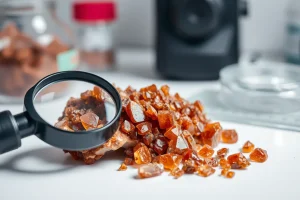
Colemanite is characterized by its high boron concentration and is typically found in massive, crystalline aggregates. It lacks the optical tricks of Ulexite and the hardness of Boracite but is the most economically significant for industrial boron extraction.
Suitability by Use
Because of their chemical and physical properties, these minerals are suited for very different purposes:
- Collector Specimens: Boracite is highly sought after for its geometric crystal forms. Ulexite is a favorite for educational displays due to its optical properties.
- Industrial Application: Colemanite is the preferred mineral for the manufacture of borax and borosilicate glass.
- Jewelry: None of these minerals are suitable for daily-wear jewelry. However, Boracite may be used in protected settings for niche mineral jewelry.
Identification Limits
Distinguishing these minerals in the field can be challenging without basic tools. Hardness testing is the most reliable method: Ulexite can be scratched by a fingernail, Colemanite by a copper coin, and Boracite requires a steel knife. Optical inspection quickly identifies Ulexite via its fiber-optic transmission, while Boracite is identified by its isometric crystal symmetry.
Related Profiles
For those interested in borates, further study of Borax and Kernite is recommended, as they represent the most common commercial forms of boron minerals and share similar geological origins.
FAQ
Can Ulexite be used in jewelry?
No, Ulexite is far too soft (Mohs 2-2.5) and is prone to scratching and degradation, making it unsuitable for jewelry.
What makes Ulexite the 'TV-stone'?
Its parallel fibrous structure allows light to travel along the fibers, effectively projecting an image from the bottom of the stone to the top.
How do I tell Colemanite and Boracite apart?
The easiest way is a hardness test. Boracite is significantly harder (Mohs 5) than Colemanite (Mohs 3.5).
Leave a Reply