
Short Answer
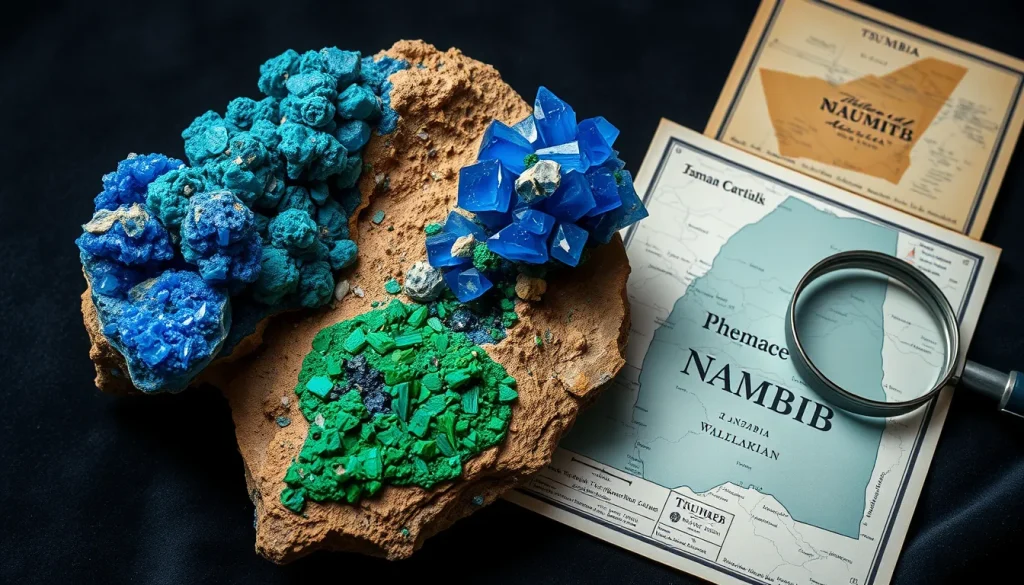
The Tsumeb Mine, located in the Otjikoto Region of Namibia, stands as a titan in the world of mineralogy. For over a century, it has been the source of some of the most aesthetically perfect and chemically complex mineral specimens ever discovered. Its reputation is not merely based on the quantity of ore extracted, but on the extraordinary diversity of secondary minerals that formed within its oxidized zones.
Documented Context
Tsumeb is globally recognized by geologists and collectors as a “mineralogical wonderland.” The mine’s significance lies in its unique combination of a primary sulfide ore body and a highly active weathering environment. This synergy allowed for the precipitation of hundreds of distinct mineral species, many of which are found nowhere else on Earth in such quality or abundance.
The mine was primarily exploited for lead, zinc, and copper. However, the true treasure for the scientific community was the oxidation zone—the upper portion of the deposit where groundwater and oxygen reacted with the primary sulfides to create a kaleidoscopic array of carbonates, arsenates, and phosphates.
Place and Period
The mine is situated near the town of Tsumeb in northern Namibia. While the deposits are millions of years old, the industrial history of the site began in the early 20th century. Mining operations intensified around 1905, with the mine reaching its peak production and mineralogical discovery phases throughout the mid-20th century.
The period between the 1950s and the mine’s eventual closure to primary production in the late 1990s saw the discovery of some of the most iconic specimens, as miners pushed deeper into the complex vein systems and encountered unexpected pockets of rare crystals.
Historical Uses
Historically, Tsumeb served two distinct purposes: industrial production and scientific research.
- Industrial Mining: The mine was a critical source of lead and zinc for global markets, utilizing advanced smelting techniques to process the complex ores.
- Mineralogical Collection: Because of the sheer variety of crystals, Tsumeb became a primary source for museums and private collections worldwide. Specimens were often collected by mine employees and specialized dealers who recognized the rarity of the secondary minerals.
Expert Insight: The Tsumeb locality is often cited in gemological literature as the gold standard for “locality value.” A specimen’s provenance from Tsumeb can exponentially increase its market value due to the mine’s closed status and historical prestige.
Later Interpretations
In later years, the interpretation of Tsumeb’s mineralogy shifted from simple ore extraction to a complex study of supergene enrichment. Geologists analyzed how the descending meteoric waters dissolved metals from the surface and redeposited them in the depths, creating the famous “secondary” minerals like Azurite and Malachite.
The mine also became a case study in the importance of preserving geological sites. The closure of the mine led to a surge in the value of existing specimens, highlighting the tragedy of losing access to such a diverse natural laboratory.
Modern Associations
Today, Tsumeb is associated with the high-end mineral investment market. Specimens from the mine are treated as fine art, appearing in prestigious auctions and the world’s leading natural history museums. It remains a benchmark for mineralogists studying the chemical interactions between copper, zinc, and arsenic.
Modern collectors often seek out specific Tsumeb combinations, such as the striking contrast of deep blue Azurite crystals perched on golden-yellow minerals, which have become symbolic of the locality’s unique chemical signature.
Source Limitations
Much of the data regarding the exact locations of the most productive “pockets” within the mine was kept secret by the mining companies or lost during the transition of ownership. Furthermore, because many specimens were collected informally by workers, the precise stratigraphic data for some of the most famous pieces is missing, making it difficult for modern scientists to perfectly reconstruct the environmental conditions of their formation.
FAQ
Why is Tsumeb considered the most diverse locality?
Due to a rare combination of primary sulfide ores and a specific chemical environment in the oxidation zone, allowing hundreds of different mineral species to crystallize in one place.
Can I still buy minerals from the Tsumeb mine?
Yes, but they are sold through the secondary market (dealers and auctions) as the mine is no longer producing these specimens for the public.
What is the most valuable mineral from Tsumeb?
Value depends on quality, but world-class Azurite and rare arsenates from Tsumeb are among the most prized by collectors.
Leave a Reply