
Short Answer
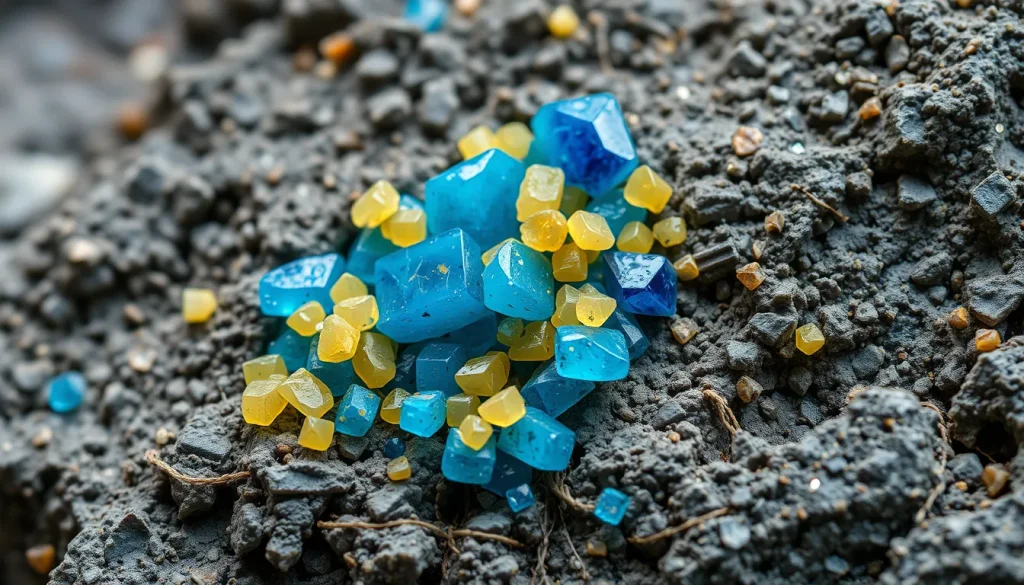
Joaquinite is a rare and complex borate mineral that holds a prestigious position among mineral collectors, primarily due to its extreme rarity and its intimate geological relationship with benitoite. While it does not possess the gemstone appeal of its more famous companion, its presence is a diagnostic marker for specific hydrothermal environments.
What Is Joaquinite?
Joaquinite is a complex hydrous borate mineral with a chemical composition typically described as CaB3O6(OH) (though variations exist). It is characterized by its occurrence as small, often colorless to pale yellow crystals. Unlike benitoite, which forms striking blue crystals, joaquinite is more subtle in appearance but scientifically significant.
The mineral is named after Joaquin Valley, reflecting its primary type locality. It forms under very specific low-temperature hydrothermal conditions where boron-rich fluids interact with glaucophane schist. Because these conditions are so localized, joaquinite is found in only a handful of locations worldwide, making it a prize for mineralogists specializing in rare borates.
Practical Uses and Limitations
Due to its extreme rarity and physical properties, joaquinite has no commercial use in jewelry or industry. Its value is purely scientific and collectible.
- Research Value: It serves as a geochemical indicator of the pressure and temperature conditions during the formation of the San Benitoite-Joaquinite assemblage.
- Collector Value: High-quality specimens, especially those where joaquinite is naturally associated with benitoite or neptunite, are highly sought after by museum curators and private collectors.
The primary limitation of joaquinite is its fragility and small crystal size, which makes it unsuitable for any application requiring durability or large-scale processing.
Identification and Look-Alikes
Identifying joaquinite requires professional equipment, as its visual characteristics are not distinct enough for naked-eye identification. It often appears as minute, transparent grains or small prismatic crystals.
| Feature | Joaquinite | Benitoite (Associate) | Other Borates |
|---|---|---|---|
| Color | Colorless to Pale Yellow | Deep Blue | Variable |
| Crystal System | Triclinic/Monoclinic | Ditrigonal Dipyramidal | Various |
| Rarity | Extreme | Very High | Moderate to High |
To the untrained eye, joaquinite may be mistaken for common calcite or other small borate minerals. However, its specific association with the benitoite-neptunite-joaquinite paragenesis is the strongest clue to its identity.
Quality and Value Factors
For the mineral collector, the value of joaquinite is determined by several key factors:
“The value of a rare mineral like joaquinite is rarely about the individual crystal’s clarity, but rather the context of the matrix and the presence of associated rare species.”
- Association: A specimen containing both benitoite and joaquinite is exponentially more valuable than joaquinite alone.
- Crystal Definition: Well-formed, distinct crystals are preferred over massive or grainy aggregates.
- Provenance: Specimens confirmed to be from the San Benito County deposits in California command the highest premiums.
FAQ
Can joaquinite be used in jewelry?
No, joaquinite is too rare and physically fragile to be used as a gemstone. It is kept exclusively as a mineral specimen.
Where is the best place to find joaquinite?
The primary and most famous source is the San Benito County region of California, specifically associated with benitoite deposits.
How does joaquinite differ from benitoite?
While both are rare and found together, benitoite is a barium titanium silicate (blue), whereas joaquinite is a complex borate (colorless/yellow).
Leave a Reply