
Short Answer
Lead and copper carbonate minerals represent some of the most visually arresting specimens in the mineral kingdom. Characterized by their intense saturation and often dramatic crystalline habits, these secondary minerals form in the oxidation zones of copper and lead ore deposits. For the collector, they offer a fascinating intersection of chemistry, geology, and aesthetic beauty.
What Is a Lead and Copper Carbonate?
Lead and copper carbonates are minerals composed of lead (Pb) or copper (Cu) combined with the carbonate ion (CO32-). These are typically secondary minerals, meaning they are not the original minerals deposited by hydrothermal fluids, but rather the result of the chemical weathering (oxidation) of primary sulfide minerals like chalcopyrite or galena in the presence of carbonate-rich waters.
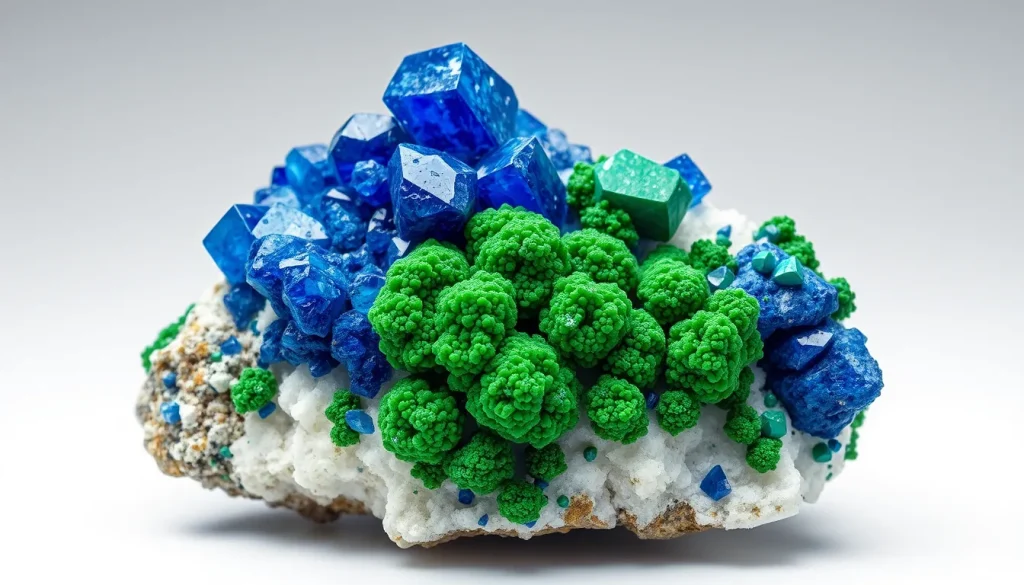
The most iconic examples include Malachite and Azurite (copper carbonates) and Cerussite (a lead carbonate). Because they form in the “gossan” or oxidized cap of an ore body, they often appear as colorful crusts, botryoidal masses, or delicate crystals atop a matrix of limestone or quartz.
Varieties and Related Materials
While dozens of rare species exist, collectors primarily focus on a few key varieties:
- Malachite: Known for its vibrant green color and characteristic botryoidal (grape-like) habit. It is the most stable copper carbonate.
- Azurite: Famous for its deep “azure” blue. It is less stable than malachite and often converts to malachite over time (pseudomorphism).
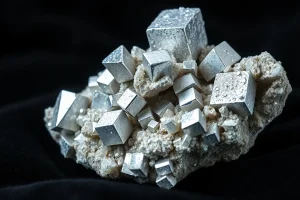
- Cerussite: A lead carbonate that often forms high-luster, colorless to white crystals. It is prized for its high refractive index, which gives it a diamond-like brilliance.
- Aurichalcite: A zinc-copper carbonate that often appears as pale blue, needle-like crystals.
Identification and Look-Alikes
Accurate identification requires a combination of visual inspection and physical testing. The following table highlights the primary distinctions:
| Mineral | Primary Color | Key Feature | Hardness (Mohs) |
|---|---|---|---|
| Malachite | Bright Green | Banded patterns/Botryoidal | 3.5 – 4 |
| Azurite | Deep Blue | Tabular crystals/Deep hue | 3.5 – 4 |
| Cerussite | Colorless/White | Adamantine luster/High density | 3 – 3.5 |
Expert Tip: To distinguish Malachite from other green minerals like Chrysocolla, perform a simple acid test. Carbonates will effervesce (bubble) when exposed to dilute hydrochloric acid, whereas silicates will not.
Quality and Value Factors
For collectors, the value of lead and copper carbonates is determined by several critical factors:
- Color Saturation: Deep, vivid blues in Azurite and rich, saturated greens in Malachite command higher premiums.
- Crystal Habit: Well-defined, sharp crystals are significantly more valuable than massive or botryoidal forms.
- Association: Specimens where Azurite and Malachite occur together on a contrasting matrix (such as white calcite or brown limonite) are highly sought after.
- Luster: For Cerussite, a high “adamantine” luster is essential for top-tier specimens.
Jewelry Suitability and Care
Due to their relatively low hardness and chemical sensitivity, these minerals are not suitable for high-wear jewelry (like rings). They are best used in pendants or as collector’s cabinet specimens.
Care Guidelines:</n
- Avoid Acids: Never use acidic cleaners, as they will dissolve the mineral.
- Avoid Harsh Chemicals: Use only a soft brush and distilled water for cleaning.
- Light Sensitivity: While generally stable, some deep blue azurites can fade if exposed to prolonged, intense UV light.
FAQ
Why does Azurite often turn green?
Azurite is chemically less stable than Malachite. Over time, exposure to moisture and air causes it to hydrate and convert into Malachite, a process known as pseudomorphism.
Are these minerals toxic?
While lead carbonates like Cerussite contain lead, they are generally safe to handle. However, you should avoid inhaling dust from them and always wash your hands after handling raw specimens.
How can I tell Malachite from Green Jasper?
Malachite typically exhibits concentric banding and is much softer (3.5-4) than Jasper (6.5-7). Additionally, Malachite will react to acid.
Leave a Reply