Short Answer
Plagioclase feldspar is not a single mineral but a complex solid solution series of tectosilicate minerals. For the gemstone enthusiast and professional, understanding plagioclase requires moving beyond a single name and instead viewing it as a chemical spectrum where sodium (Na) and calcium (Ca) substitute for one another within the crystal lattice.
What Is Plagioclase Feldspar?
Plagioclase is a group of feldspar minerals that form a continuous series between the sodium-rich endmember Albite (NaAlSi3O8) and the calcium-rich endmember Anorthite (CaAl2Si2O8). Because these two elements have similar ionic radii, they can replace each other during the crystal’s growth, resulting in a variety of intermediate compositions.
In gemology, these minerals are prized for their vitreous luster, diverse colors, and specific optical phenomena. While often overlooked in favor of more famous gemstones, the plagioclase group includes some of the most visually striking minerals found in igneous and metamorphic rocks.
Varieties and Related Materials
The plagioclase series is categorized by the percentage of anorthite (Ca) present in the sample. This chemical shift determines the specific name and physical properties of the mineral.
Albite (The Sodium Endmember)
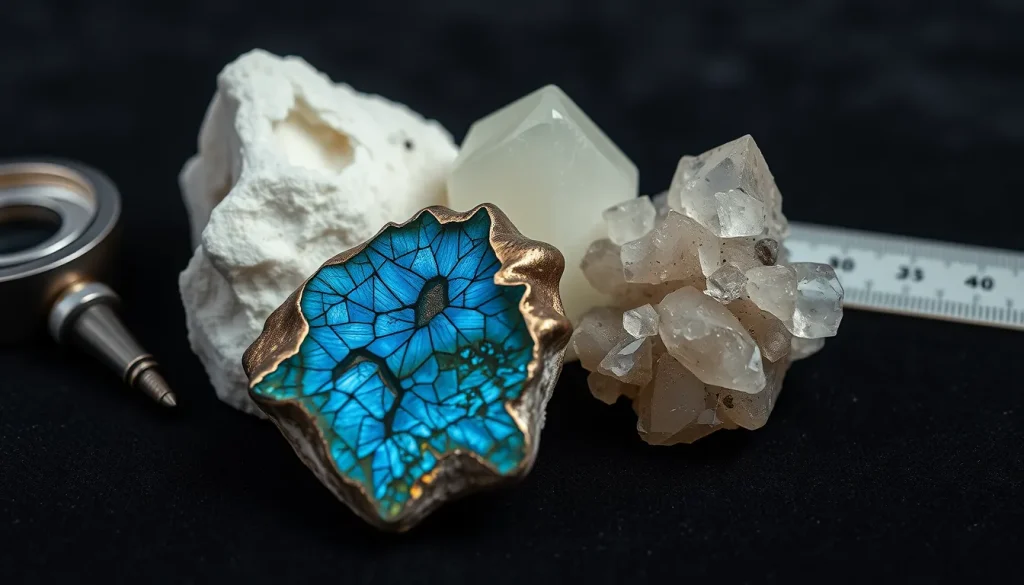
Albite is the sodium-rich end of the spectrum. It is most famous for its variety Rainbow Moonstone (though true moonstone is often a mix of orthoclase and albite) and Labradorite. Labradorite exhibits the stunning “labradorescence,” an optical effect caused by exsolution lamellae that diffract light.
Andesine (The Intermediate)
Andesine sits in the middle of the series. In the gemstone trade, “Andesine” is often used as a commercial term for a variety of colorless to pale yellow-green feldspars. It is important to note that many stones sold as andesine are actually high-sodium plagioclase variants that may not strictly fit the mineralogical definition of andesine.
Anorthite (The Calcium Endmember)
Anorthite is the calcium-rich endmember. While less common as a faceted gemstone due to its tendency to be more opaque or white, it is scientifically significant as the primary component of the lunar highlands, making it a “space gemstone” of sorts.
Identification and Look-Alikes
Identifying plagioclase requires a combination of visual inspection and instrumental analysis. The most defining characteristic of the plagioclase group is the presence of polysynthetic twinning, which appears as fine, parallel striations on the cleavage faces under a microscope.
| Feature | Plagioclase | Quartz | Calcite |
|---|---|---|---|
| Hardness (Mohs) | 6.0 – 6.5 | 7.0 | 3.0 |
| Cleavage | Two directions (approx 90°) | None (Conchoidal) | Three directions (Rhombohedral) |
| Luster | Vitreous to Pearly | Vitreous | Vitreous to Waxy |
Gemologist Tip: To distinguish plagioclase from quartz, look for the cleavage planes. Quartz will never show a flat, reflective cleavage surface, whereas plagioclase will show distinct planes of breakage.
Jewelry Suitability and Care
With a Mohs hardness of 6 to 6.5, plagioclase minerals are moderately durable but are susceptible to scratching if worn in rings for daily use. They are best suited for earrings, pendants, or protective settings.
- Avoid Harsh Chemicals: Acidic cleaners can etch the surface of feldspars.
- Cleaning: Use warm, soapy water and a soft brush.
- Storage: Store separately from harder gemstones like diamonds or sapphires to prevent surface scratches.
Quality and Value Factors
The value of plagioclase is driven primarily by optical effects rather than raw clarity:
- Adularescence/Labradorescence: The intensity, color range, and “flash” of the schiller effect are the primary value drivers for Labradorite and Moonstone.
- Color: For non-phenomenal plagioclase, rare colors like deep blue or vibrant yellow increase value.
- Transparency: While most are translucent, rare transparent crystals command a premium for faceting.
FAQ
Is Andesine a real gemstone?
Yes, though in the trade, the term is often used broadly for various plagioclase feldspars. Mineralogically, it is a specific composition between albite and anorthite.
What is the difference between Moonstone and Labradorite?
Both are plagioclase feldspars. Moonstone typically shows a soft, billowy light (adularescence), while Labradorite shows a more metallic, colorful flash (labradorescence).
Can plagioclase be used in everyday jewelry?
Yes, but because its hardness is around 6-6.5, it should be handled with care and avoided in high-impact settings like engagement rings.
Leave a Reply