
Short Answer
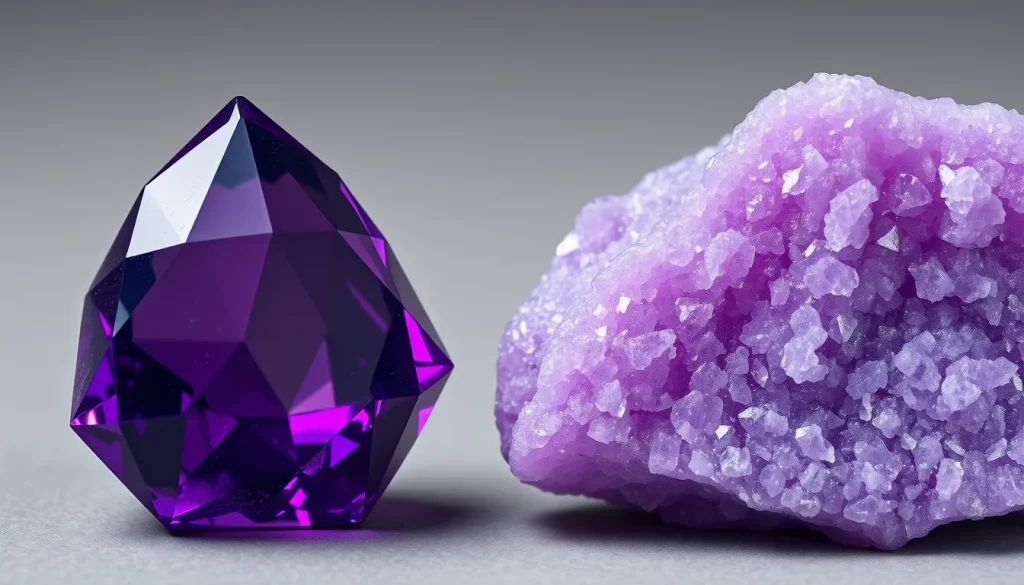
To the untrained eye, a piece of lepidolite and a piece of amethyst may look nearly identical due to their shared purple coloration. However, from a gemological perspective, these two minerals are fundamentally different in every way—from their atomic arrangement to their physical durability. Understanding these distinctions is essential for collectors and jewelers to ensure proper care and accurate valuation.
Comparison Table
| Feature | Amethyst | Lepidolite |
|---|---|---|
| Mineral Family | Quartz (Silicate) | Mica (Phyllosilicate) |
| Hardness (Mohs) | 7 | 2.5 – 3 |
| Crystal System | Trigonal | Monoclinic |
| Luster | Vitreous (Glassy) | Pearly to Metallic |
| Cleavage | Poor/None | Perfect Basal (Sheets) |
| Transparency | Transparent to Translucent | Opaque to Translucent |
Shared Features
The primary commonality between amethyst and lepidolite is their color palette. Both minerals can range from a pale, lilac lavender to a deep, royal purple. In some cases, both may exhibit color zoning, where different shades of purple appear in bands or patches within a single specimen. Additionally, both are frequently found in pegmatite environments, though their specific formation conditions differ.
Important Differences
Chemical Composition and Structure
Amethyst is a variety of quartz, composed of silicon dioxide (SiO2). Its purple color is the result of irradiation and the presence of iron impurities. In contrast, lepidolite is a complex lithium-aluminum phyllosilicate. The presence of lithium is a defining characteristic of lepidolite, making it an important ore for lithium extraction.
Physical Durability and Texture
The most striking difference is the hardness. Amethyst is a durable stone (Mohs 7), capable of being faceted and worn in rings. Lepidolite is extremely soft (Mohs 2.5–3) and fragile. While amethyst breaks with a conchoidal (shell-like) fracture, lepidolite exhibits perfect basal cleavage, meaning it splits easily into thin, flexible, shimmering sheets—a hallmark of the mica family.
Optical Properties
Amethyst typically possesses a vitreous luster, reflecting light like glass, and is often highly transparent. Lepidolite has a pearly or slightly metallic luster and is generally more opaque, often appearing as a mass of tiny, glittering scales rather than a single clear crystal.
Suitability by Use
Because of their disparate physical properties, these two stones serve very different purposes in the market:
- Amethyst: Ideal for high-end jewelry, including rings, necklaces, and earrings. Its hardness makes it suitable for daily wear and professional polishing.
- Lepidolite: Primarily used as a collector’s mineral, in metaphysical practices, or in low-impact jewelry such as cabochons for pendants. It is too soft for rings and can be easily scratched by common household dust.
Identification Limits
Gemologist’s Tip: If you are unsure which stone you have, try the “scratch test” carefully on an inconspicuous area. A copper penny (approx. 3.5 Mohs) will easily scratch lepidolite but will leave no mark on amethyst.
While visual inspection usually suffices, some low-grade, cloudy amethyst can be mistaken for lepidolite. However, the lack of “shimmering flakes” or sheet-like peeling in amethyst is a definitive indicator. Under a microscope, lepidolite will show a platy structure, whereas amethyst will show the typical crystalline structure of quartz.
Related Profiles
For those interested in purple minerals, it is also worth researching Fluorite (which is also purple but has a distinct cubic structure) and Sugilite (a rare, opaque purple mineral that is harder than lepidolite but softer than amethyst).
FAQ
Can I wear lepidolite in a ring?
It is not recommended. Lepidolite is too soft (Mohs 2.5-3) and will scratch or chip very quickly if worn on a finger.
Does lepidolite sparkle more than amethyst?
Lepidolite has a 'glittery' sparkle due to its platy structure reflecting light from many small surfaces, whereas amethyst has a deeper, internal brilliance when faceted.
How can I tell them apart without tools?
Look for the 'sheets.' If the stone looks like it's made of tiny overlapping scales or can be peeled into thin layers, it is lepidolite. If it is a solid, glassy crystal, it is likely amethyst.
Leave a Reply