
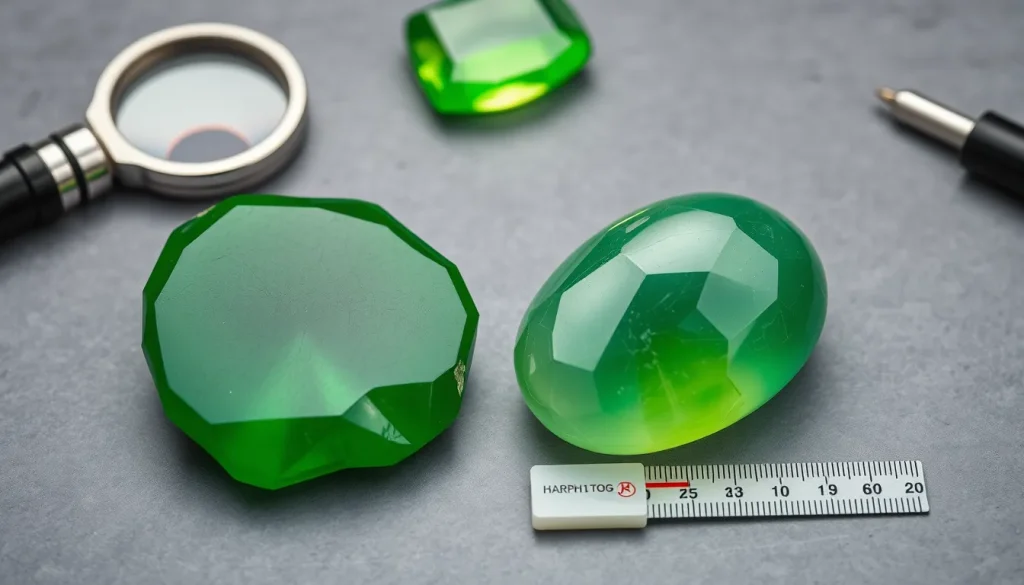
Short Answer
In the world of gemology, the term “jade” is not a single mineral species but rather a commercial trade name applied to two entirely different silicate minerals: nephrite and jadeite. While they may appear similar to the untrained eye, they differ fundamentally in their chemical structures, physical properties, and geological origins.
Comparison Table
| Feature | Nephrite | Jadeite |
|---|---|---|
| Mineral Group | Amphibole | Pyroxene |
| Chemical Formula | Ca2(Mg, Fe)5Si8O22(OH)2 | NaAlSi2O6 |
| Hardness (Mohs) | 6.0 – 6.5 | 6.5 – 7.0 |
| Luster | Greasy to waxy | Vitreous (glassy) to greasy |
| Transparency | Usually opaque to translucent | Translucent to transparent |
| Fracture | Splintery | Conchoidal to uneven |
| Typical Colors | Dark green, creamy white, grey | Imperial green, lavender, orange, white |
Shared Features
Despite their mineralogical differences, nephrite and jadeite share several characteristics that lead to their grouping under the umbrella term “jade”:
- Color Palette: Both minerals are most famous for their various shades of green, ranging from pale celadon to deep forest green.
- Cultural Significance: Both have been prized for millennia, particularly in East Asian cultures, as symbols of purity, moral integrity, and status.
- Toughness: Both materials are exceptionally “tough” (resistant to fracturing), making them ideal for carving intricate sculptures and durable jewelry.
Important Differences
The primary distinction lies in the crystal structure. Nephrite is an amphibole with an interlocking, felt-like microstructure of fibers, which gives it incredible impact resistance. Jadeite is a pyroxene with a more granular, crystalline structure.
Visual and Tactile Qualities
Nephrite typically exhibits a greasy luster and a more muted, saturated color. It is rarely transparent. Jadeite, conversely, often possesses a vitreous (glassy) luster and can achieve a level of transparency that allows light to pass through clearly, especially in high-grade “Imperial Jade.”
Hardness and Durability
While jadeite is slightly harder on the Mohs scale, nephrite is often considered “tougher” because its fibrous structure prevents cracks from propagating. This is why nephrite was historically used for axe heads and weaponry.
Expert Tip: To distinguish the two visually, look at the translucency. If the stone has a “glassy” glow and a vivid, bright color, it is more likely to be jadeite. If it has a soft, waxy appearance and a deep, creamy green, it is likely nephrite.
Suitability by Use
The choice between nephrite and jadeite often depends on the intended final product:
- Fine Jewelry: Jadeite is the preferred choice for high-end jewelry (rings, pendants) due to its superior brilliance, transparency, and range of vivid colors.
- Large Scale Carvings: Nephrite is often favored for large sculptures and traditional ornaments because its toughness makes it less prone to chipping during the carving process.
- Investment Pieces: Top-quality, translucent “Imperial” jadeite commands the highest prices in the gemstone market, often exceeding the price of diamonds per carat.
Identification Limits
Identifying jade in the field can be challenging because many other minerals mimic their appearance. Common look-alikes include:
- Serpentine: Often mistaken for nephrite; however, it is significantly softer and lacks the same toughness.
- Chalcedony/Agate: Can mimic the colors of jade but lacks the characteristic luster and fibrous structure.
- Glass/Plastic: Synthetic imitations are common; these can be identified by their lack of natural inclusions and abnormal lightness.
Definitive identification requires laboratory testing, such as X-ray diffraction (XRD) or refractive index (RI) measurement.
Related Profiles
For those interested in similar silicate minerals, we recommend exploring the profiles of Serpentine, Chrysoprase, and Amazonite to understand the broader spectrum of green gemstones.
FAQ
Is nephrite real jade?
Yes, nephrite is one of the two minerals officially recognized as jade, along with jadeite.
Which one is more expensive?
Generally, jadeite is more expensive, particularly the translucent 'Imperial Jade' variety, although high-quality nephrite is also valued.
Can I tell them apart at home?
It is difficult, but jadeite is typically more transparent and glassy, while nephrite is more opaque and waxy. Professional testing is recommended for certainty.
Leave a Reply