
Short Answer
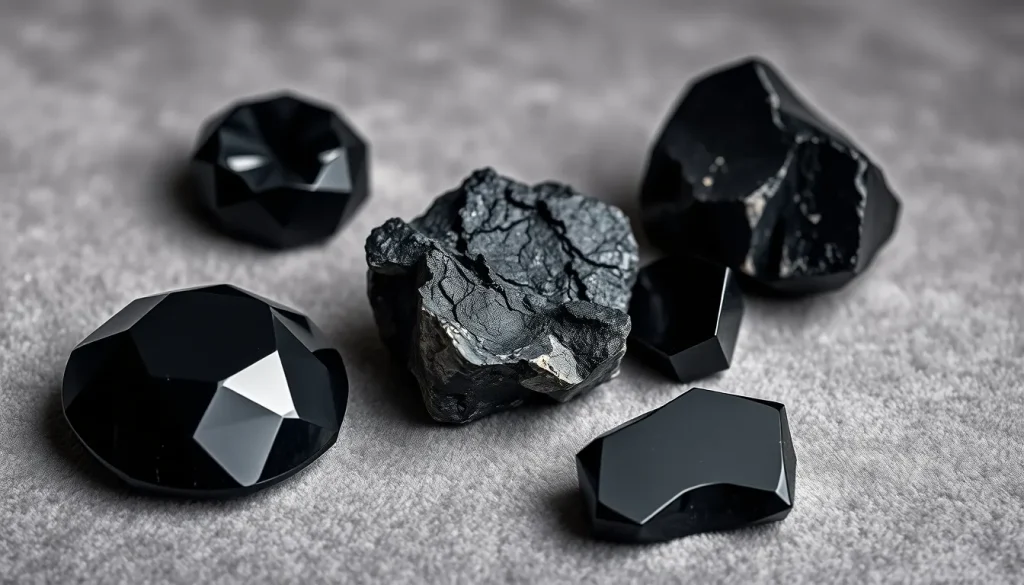
Black gemstones have long fascinated collectors and jewelers alike, offering a sophisticated aesthetic that ranges from the deep, ink-like opacity of Onyx to the brilliant, metallic luster of Hematite. While often associated with mystery or mourning in Western cultures, these stones are scientifically diverse, encompassing everything from pure carbon to complex silicates.
What Is a Black Gemstone?
In gemology, a “black gemstone” is not a single mineral species but a category of minerals that appear black due to the presence of specific trace elements or high concentrations of opaque minerals. The black color is typically caused by the absorption of all visible light wavelengths. Some stones are naturally black throughout (like Obsidian), while others are the result of intense coloration in a variety of minerals (like Black Tourmaline).
Varieties and Related Materials
The spectrum of black gemstones is vast, divided primarily between precious stones, semi-precious minerals, and organic materials.
- Black Diamond: Composed of carbon with inclusions of graphite or other minerals that create an opaque or translucent black appearance.
- Black Onyx: A variety of chalcedony (quartz) known for its parallel bands, though commercial onyx is often dyed to achieve a solid black hue.
- Black Tourmaline (Schorl): A complex boron silicate known for its strong electrical properties and deep, vitreous black color.
- Obsidian: A volcanic glass formed by the rapid cooling of silica-rich lava, resulting in a smooth, conchoidal fracture.
- Hematite: An iron oxide mineral with a distinct metallic luster and high specific gravity.
Identification and Look-Alikes
Because many black stones look identical to the naked eye, professional identification is crucial. Gemologists use several diagnostic tools to differentiate them:
| Gemstone | Luster | Hardness (Mohs) | Key Identifier |
|---|---|---|---|
| Black Diamond | Adamantine | 10 | Extreme hardness, high refractive index |
| Black Onyx | Waxy to Vitreous | 6.5 – 7 | Microcrystalline structure |
| Black Tourmaline | Vitreous | 7 – 7.5 | Strong pyroelectric properties |
| Obsidian | Vitreous | 5 – 5.5 | Glassy, shell-like (conchoidal) fractures |
Jewelry Suitability and Care
The durability of a black gemstone determines its placement in jewelry. For instance, Black Diamonds are suitable for engagement rings due to their hardness, whereas Obsidian is too fragile for daily wear on a ring and is better suited for pendants.
Expert Tip: When cleaning black gemstones, avoid ultrasonic cleaners for stones like Obsidian or Opal, as they can crack. Use lukewarm soapy water and a soft brush to maintain the polish.
Symbolism and Modern Beliefs
Across various cultures, black gemstones are attributed with properties of protection and grounding. In modern metaphysical practices, stones like Black Tourmaline and Onyx are believed to act as “shields” against negative energy. Historically, black stones were used in ancient Egypt and Rome to symbolize power, authority, and the transition between life and death.
Quality and Value Factors
The value of black gemstones is primarily driven by luster and uniformity. A stone with a “flat” or dull appearance is generally less valuable than one with a deep, mirror-like polish. For Black Diamonds, the presence of internal inclusions that affect the overall saturation of the black color can influence the price.
FAQ
Is all black onyx natural?
While onyx is a natural mineral, much of the solid black onyx sold in jewelry stores is actually dyed chalcedony to ensure a uniform, deep black color.
Which black gemstone is best for everyday wear?
Black Diamond and Black Tourmaline are highly durable. For a more affordable but still durable option, Black Onyx is an excellent choice for most jewelry.
How can I tell the difference between Obsidian and Onyx?
Obsidian is a volcanic glass and will have conchoidal fractures and a lower hardness (5-5.5), whereas Onyx is a quartz variety and is significantly harder (6.5-7).
Leave a Reply