
Short Answer
Definition
In gemology and mineralogy, complex oxide minerals are chemical compounds consisting of two or more metallic elements bonded to oxygen. Unlike simple oxides (such as cuprite or hematite), which contain only one metal species, complex oxides feature a more intricate lattice structure where various cations occupy different sites within the oxygen framework. These minerals are fundamental to the gemstone world, as they often exhibit exceptional hardness, high refractive indices, and vivid coloration.
Plain-English Explanation
Think of a simple oxide as a basic recipe: one type of metal mixed with oxygen. A complex oxide is like a gourmet recipe; it mixes several different metals with oxygen to create a more stable and often more beautiful crystal. Because these minerals involve multiple elements, they can ‘swap’ certain atoms for others (a process called substitution), which is exactly what gives many gemstones their diverse colors. For example, the same basic complex oxide structure can produce a deep red ruby or a royal blue sapphire depending on which trace elements are present.
Example
The most prominent examples of complex oxides in the gem trade include:
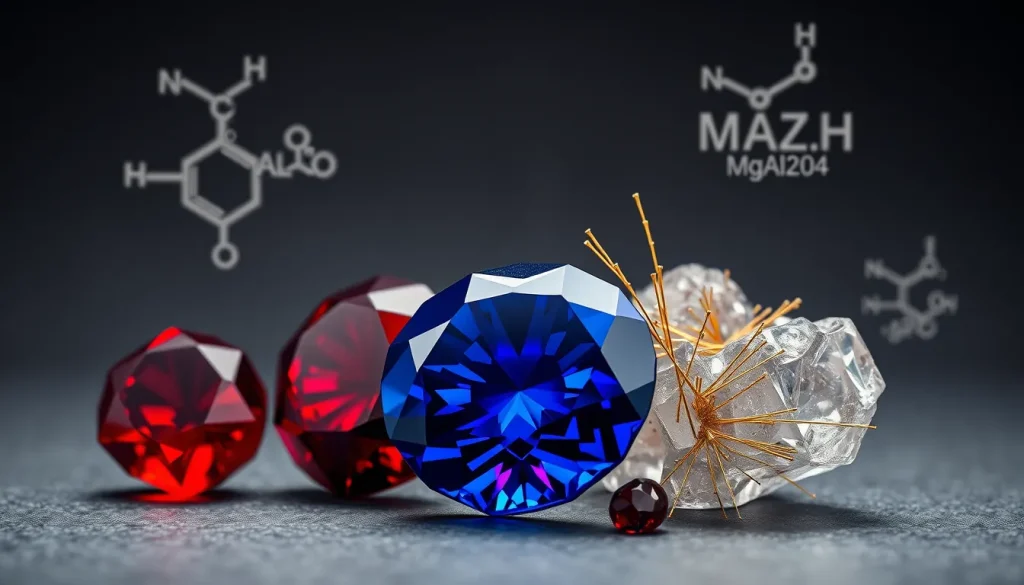
- Corundum (Al2O3): While technically a simple oxide in its pure form, it becomes a complex system when chromium, iron, or titanium substitute into the lattice to create rubies and sapphires.
- Spinel (MgAl2O4): A classic complex oxide containing both magnesium and aluminum. It is often mistaken for ruby due to its similar color and hardness.
- Rutile (TiO2): A titanium oxide that frequently occurs as needle-like inclusions (rutilation) in other gemstones.
- Cassiterite (SnO2): A tin oxide that can form rare, gem-quality crystals.
Expert Tip: When identifying complex oxides, always look at the specific gravity. Because these minerals often contain heavy metals, they tend to be denser than silicates of a similar appearance.
Why It Matters
Understanding complex oxides is critical for the professional gemologist for several reasons:

- Identification: Many complex oxides look identical to the naked eye. For instance, distinguishing between a red spinel and a red corundum requires knowledge of their differing crystal systems and refractive indices.
- Durability: Complex oxides are generally known for their superior hardness (often 7.0 to 9.0 on the Mohs scale), making them highly suitable for jewelry.
- Color Origin: The chemistry of complex oxides explains allochromatism—where the color is caused by impurities rather than the pure chemical composition of the mineral.
- Value Assessment: Rare substitutions in complex oxides can lead to ‘fancy’ colors that significantly increase the market value of a specimen.
FAQ
What is the difference between a simple oxide and a complex oxide?
A simple oxide contains only one metal element bonded to oxygen (e.g., Hematite), whereas a complex oxide contains two or more different metal elements (e.g., Spinel).
Are all oxide minerals hard enough for jewelry?
Not all, but many of the gem-quality complex oxides, such as corundum and spinel, are among the hardest minerals on Earth.
Why are complex oxides often so colorful?
Their structure allows for the substitution of transition metals (like Chromium or Iron), which absorb specific wavelengths of light and create vivid colors.

Leave a Reply