
Short Answer
Definition
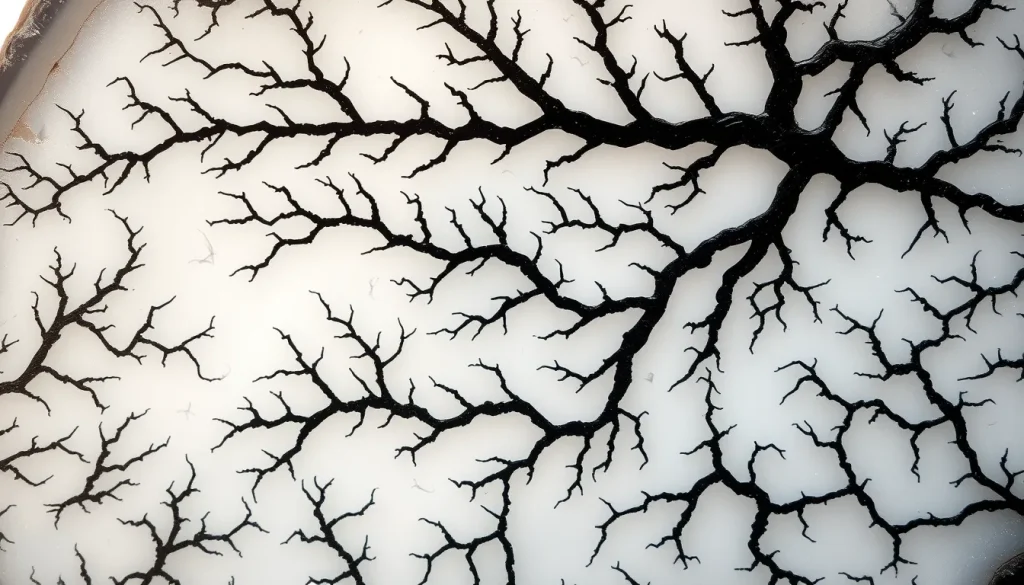
Dendritic inclusions are mineral growths that form branching, tree-like, or fern-like patterns within a host gemstone or mineral. Derived from the Greek word dendron, meaning ‘tree,’ these structures are not fossils or organic remains, but rather crystalline growths that mimic biological forms. They are most commonly encountered in chalcedony, agate, and opal, where they appear as dark, contrasting lines against a lighter background.
Plain-English Explanation
Imagine a tiny crack in a gemstone. Over millions of years, mineral-rich water seeps into that crack. Instead of filling the space evenly, the minerals—usually manganese or iron oxides—crystallize in a rapid, branching fashion. This happens because the minerals grow faster at the edges and tips of the crystals than in the center, creating a pattern that looks exactly like a winter tree, a piece of moss, or a snowflake.
It is a common misconception that these are trapped plants or algae. In reality, they are purely inorganic chemical reactions. The ‘branches’ are simply the way certain minerals prefer to stack their atoms when they are forced to grow in a confined, narrow space within another mineral.
Example
The most iconic example of dendritic inclusions is found in Dendritic Agate (often marketed as ‘Moss Agate’ or ‘Tree Agate’). In these specimens, a milky white or translucent quartz base is crisscrossed with deep black or forest green branching patterns. Another striking example occurs in White Opal, where dark dendritic plumes can create a dramatic contrast against the iridescent play-of-color.

Gemologist’s Tip: To distinguish a true dendritic inclusion from a fossil, look for the symmetry and the ‘fractal’ nature of the branching. Fossils typically show cellular structure or anatomical consistency, whereas dendrites follow a mathematical, repeating branching pattern.
Why It Matters
Understanding dendritic inclusions is crucial for several reasons in the world of gemology and collecting:
- Identification: Recognizing dendrites helps gemologists differentiate between organic inclusions (like carbonaceous matter) and inorganic mineral growths.
- Aesthetic Value: While inclusions are often seen as ‘flaws’ that decrease a stone’s value, dendritic patterns are highly prized for their artistic quality, often turning a common agate into a collector’s piece.
- Geological Dating: The presence and orientation of dendrites can provide clues about the secondary mineral fluids that passed through a rock formation long after the primary crystal had formed.
- Market Differentiation: Knowledge of these patterns prevents buyers from paying premiums for ‘fossilized plants’ that are actually just mineral oxides.
FAQ
Are dendritic patterns actually fossils of ancient plants?
No. Despite their appearance, they are inorganic mineral growths, typically manganese or iron oxides, and not organic plant matter.
Do dendritic inclusions make a gemstone less valuable?
Generally, no. In stones like agate and opal, these patterns are considered decorative and can actually increase the value for collectors.
Can you find dendritic inclusions in diamonds?
While rare, some diamonds can have inclusions, but the classic 'tree-like' dendritic patterns are almost exclusively found in silica-based minerals like quartz and opal.
Leave a Reply