
Short Answer
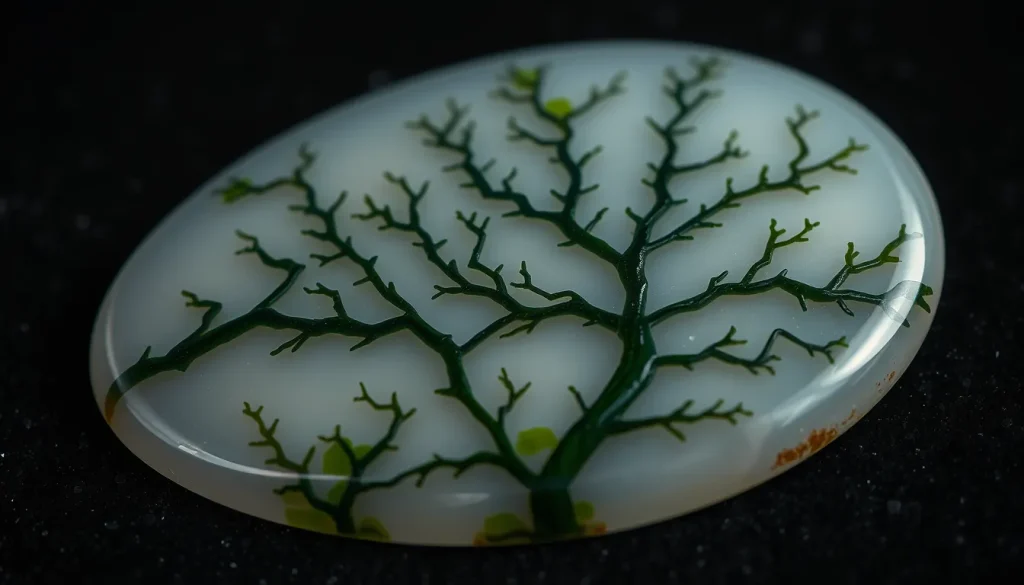
Tree Agate, often referred to as Dendritic Agate, is a visually striking variety of chalcedony characterized by branching, plant-like inclusions. While it may appear to contain fossilized ferns or trees, these patterns are actually the result of mineral precipitates, making it a favorite among collectors who appreciate the intersection of geology and organic art.
What Is Tree Agate?
Tree Agate is a cryptocrystalline variety of quartz (chalcedony) that contains inclusions of manganese or iron oxides. These oxides seep into the microscopic cracks of the silica gel during the stone’s formation, crystallizing into arborescent (tree-like) patterns known as dendrites.
Unlike true fossils, which are the remains of organic matter, the “trees” in Tree Agate are purely mineralogical. The base material is typically a milky white, grey, or translucent chalcedony, providing a high-contrast background for the dark green or black dendritic plumes.
Identification and Look-Alikes
Identifying Tree Agate requires a close examination of the inclusions and the base material. Because it is a form of chalcedony, it shares many physical properties with other agates.
Key Identification Markers
- Visual Pattern: Branching, fractal-like structures that mimic moss, ferns, or trees.
- Hardness: 6.5 to 7 on the Mohs scale, making it durable for jewelry.
- Luster: Waxy to vitreous.
- Transparency: Ranges from translucent to opaque.
Common Look-Alikes
| Gemstone | Difference from Tree Agate |
|---|---|
| Moss Agate | Moss agate typically has softer, cloud-like “mossy” inclusions rather than the sharp, branching lines of Tree Agate. |
| Dendritic Opal | Often shares similar patterns but possesses a different luster and lower hardness (5.5 to 6.5). |
| Jasper | Jasper is opaque and lacks the translucent chalcedony base typical of high-quality Tree Agate. |
Practical Uses and Limitations
Due to its hardness and relative stability, Tree Agate is versatile, though its primary value lies in its aesthetic pattern rather than its rarity.
Jewelry and Ornamentation
Tree Agate is most commonly used in cabochons to showcase the dendritic patterns. It is frequently fashioned into pendants, beads, and worry stones. Because it is a chalcedony, it polishes to a high, smooth finish.
Limitations
While durable, Tree Agate is susceptible to scratching if exposed to harder minerals (like diamonds or sapphires). It is not typically faceted because its beauty is found in the internal patterns, which would be disrupted by the facets of a traditional gemstone cut.
Jewelry Suitability and Care
Tree Agate is an excellent choice for daily-wear jewelry due to its toughness. However, to maintain its luster, proper care is required.
Expert Tip: Avoid using ultrasonic cleaners on Tree Agate, as some specimens may have microscopic fractures that could expand under high-frequency vibrations. Stick to mild soap and warm water.
- Cleaning: Use a soft cloth and mild detergent.
- Storage: Store separately from harder gemstones to prevent surface scratches.
- Chemicals: Avoid harsh acids or bleach, which can etch the surface of the quartz.
Symbolism and Modern Beliefs
In modern metaphysical circles, Tree Agate is deeply associated with the natural world and the concept of stability.
It is often viewed as a stone of growth and abundance, mirroring the branching patterns within the stone. Many believe it helps the wearer feel more grounded and connected to the Earth, promoting a sense of peace and environmental awareness. It is frequently used in meditation practices focused on renewal and the cyclical nature of life.
FAQ
Are the trees in Tree Agate real fossils?
No, they are not fossils. They are mineral inclusions of manganese or iron oxides that grew in a branching pattern, mimicking the look of plants.
What is the difference between Tree Agate and Moss Agate?
Tree Agate features sharp, distinct, branching lines (dendrites), whereas Moss Agate has softer, more rounded, cloud-like inclusions that look like moss.
Is Tree Agate suitable for rings?
Yes, with a hardness of 6.5-7, it is durable enough for rings, though it should be protected from harder materials to avoid scratches.
Leave a Reply