Short Answer
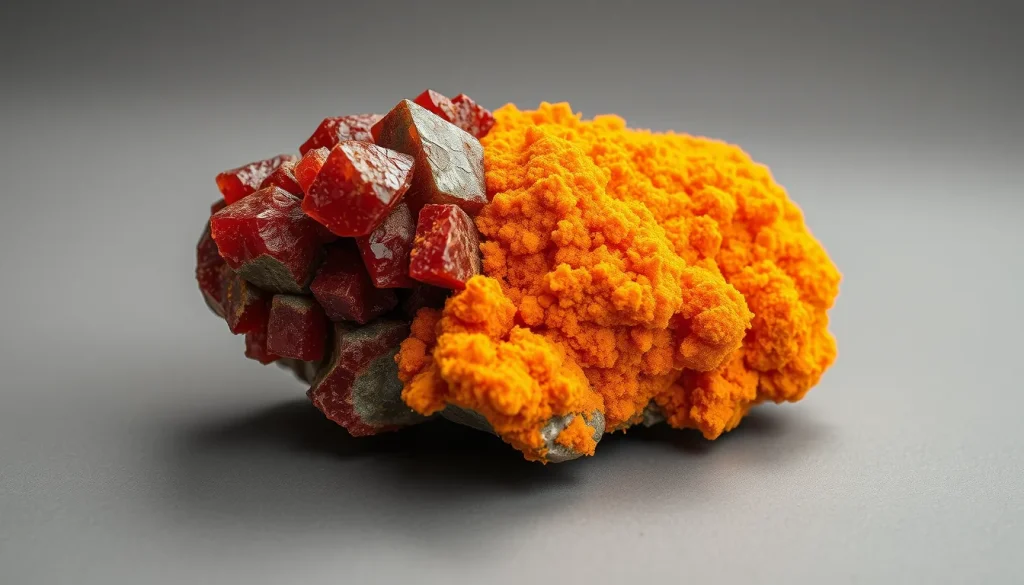
Pararealgar is a striking, bright orange mineral that often appears as a powdery crust or massive aggregates. While it shares a chemical formula with its parent mineral, Realgar, it possesses a distinct crystal structure and physical stability profile that makes it a subject of great interest for mineralogists and collectors.
What Is Pararealgar?
Pararealgar is an arsenic sulfide mineral with the chemical formula As4S4. It is technically a polymorph of Realgar, meaning it has the same chemical composition but a different atomic arrangement. Unlike Realgar, which is typically a deep red, Pararealgar is characterized by its vibrant orange to yellow-orange hue.
The formation of Pararealgar is most commonly the result of a process known as photo-induced phase transformation. When Realgar is exposed to light (particularly sunlight), its crystal lattice becomes unstable and collapses, transforming the red Realgar into the orange Pararealgar. This process is irreversible and often results in the mineral becoming powdery or crumbling over time.
Identification and Look-Alikes
Identifying Pararealgar requires a keen eye for color and texture, as it can be confused with other orange minerals. Key identifiers include:

- Color: Bright orange to yellowish-orange; lacks the deep red saturation of fresh Realgar.
- Luster: Typically resinous to earthy, especially in its powdery form.
- Hardness: Very soft, typically ranging from 1.0 to 2.0 on the Mohs scale.
- Streak: Yellow to orange.
It is often mistaken for Orpiment, which is also an arsenic sulfide. However, Orpiment is generally a more lemon-yellow color and has a different chemical formula (As2S3).
Practical Uses and Limitations
Due to its chemical composition, Pararealgar has very limited practical application in the jewelry industry. Its extreme softness and tendency to crumble make it unsuitable for cutting, polishing, or setting in jewelry.
Gemologist’s Warning: Pararealgar contains arsenic. It is toxic if inhaled as dust or ingested. Collectors should store specimens in airtight containers and avoid breathing in any powder produced by the mineral’s degradation.
Its primary value today is in mineral collections and scientific research regarding phase transitions in solids.
Symbolism and Modern Beliefs
In metaphysical circles, Pararealgar is sometimes associated with the movement of energy and the process of transformation, mirroring its physical transition from Realgar. It is often linked to the concept of “shedding the old” to make way for the new. However, these beliefs are not supported by scientific evidence and should be balanced with the knowledge of the mineral’s toxicity.
Varieties and Related Materials
Pararealgar is inextricably linked to the Realgar-Orpiment series. These minerals often occur together in hydrothermal veins and volcanic fumaroles. The transition from Realgar $rightarrow$ Pararealgar $rightarrow$ Orpiment (in some conditions) represents a spectrum of arsenic sulfide stability.
FAQ
Is Pararealgar the same as Realgar?
Chemically, yes (both are As4S4), but structurally and physically, no. Pararealgar is the orange, light-altered form of the red Realgar.
Is Pararealgar safe to handle?
It should be handled with caution. Because it contains arsenic and can crumble into a fine powder, it is toxic if inhaled or ingested. Wash hands after handling.
Can Pararealgar be used in jewelry?
No. It is far too soft (Mohs 1-2) and unstable for any practical jewelry application.
Leave a Reply