Short Answer
Direct Answer
Identifying natural peridot versus heat-treated peridot primarily involves analyzing the color saturation and the morphology of internal inclusions. While most peridot on the market is natural and untreated, thermal treatment is occasionally used to intensify the characteristic lime-green hue or to remove unsightly brownish tints. A natural peridot typically displays a balanced, vivid green with ‘lily pad’ inclusions, whereas heat-treated stones may exhibit an unnaturally saturated color or a lack of characteristic natural growth features.
Relevant Conditions
Thermal treatment in peridot is less common than in sapphires or rubies, but it becomes a relevant concern under the following conditions:
- Low-Grade Raw Material: Stones that are naturally pale, yellowish, or brownish may be subjected to heat to improve commercial appeal.
- High-Value Investment Pieces: When purchasing museum-grade or large investment specimens, the absence of treatment significantly impacts the market value.
- Suspiciously Uniform Color: If a large batch of peridots shows an identical, hyper-saturated green without the natural variation usually found in olivine deposits.
Recommended Steps
To differentiate between a natural and a heat-treated peridot, follow these professional diagnostic steps:
- Visual Color Inspection: Examine the stone under a daylight lamp. Natural peridot has a distinct olive-green to lime-green color. If the green appears overly ‘neon’ or lacks the subtle yellowish-green undertones typical of the species, suspect treatment.
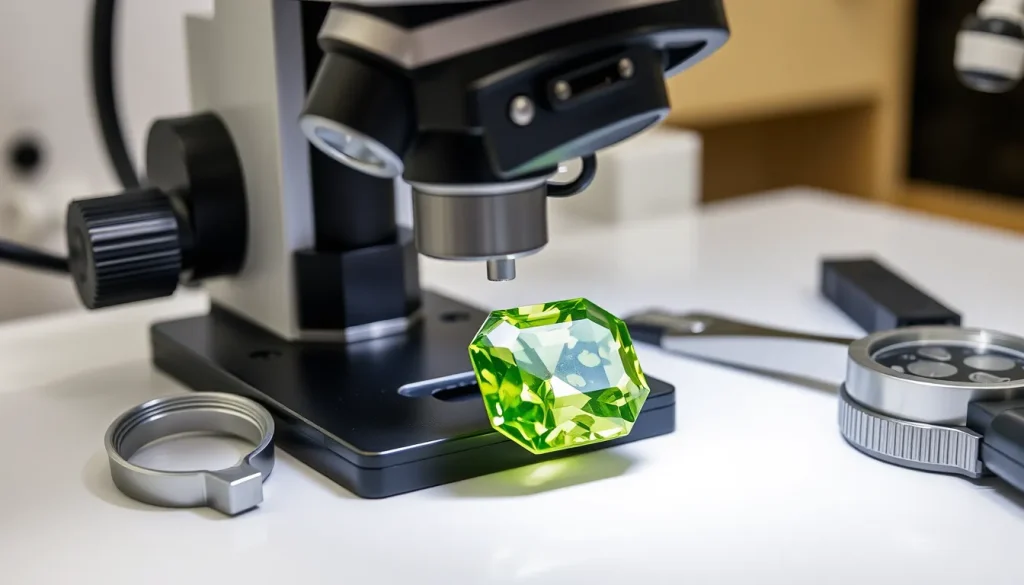
- Microscopic Inclusion Analysis: Use a 10x jeweler’s loupe or a microscope to look for “lily pads” (circular, flower-like inclusions). In natural stones, these are common. Heat treatment can sometimes alter the appearance of these inclusions or cause them to dissipate.
- Check for “Healing” Features: Look for growth zones. Heat treatment often homogenizes the color, erasing the subtle zoning patterns found in natural crystals.
- Refractive Index (RI) Testing: While heat treatment doesn’t drastically change the RI, a refractometer can confirm the stone is indeed peridot (olivine) and not a synthetic stimulant like chrome chrysobolite.
Expert Tip: Always check the edges of the crystal. Natural peridot often shows a slight color gradient from the core to the edge, whereas heat-treated stones may show a more artificial, uniform saturation across the entire facet.
Exceptions
It is important to note that not all ‘unusual’ peridots are treated. Certain exceptions include:

- Geographic Variation: Peridots from different sources (e.g., Pakistan vs. Arizona) have naturally different saturation levels and inclusion densities.
- Natural Irradiation: Some stones may have undergone natural irradiation in the earth, which can mimic the effects of artificial treatment without human intervention.
- Synthetic Peridot: Be careful not to confuse heat-treated natural peridot with synthetic peridot (created in a lab). Synthetics are often too perfect, lacking any natural inclusions entirely.
When to Ask a Professional
Because thermal treatment in peridot is subtle and does not leave obvious “burn marks” like some other gemstones, you should seek a certified gemologist (GIA or FGA) when:
- The stone is of significant size: Large stones (over 5 carats) carry higher financial risk.
- The color is exceptionally vivid: If the stone looks “too good to be true,” professional spectroscopic analysis (such as FTIR) is required.
- You require a legal certificate: For insurance or resale purposes, a laboratory report is the only definitive proof of a stone’s natural, untreated status.
FAQ
Does heat treatment make peridot more valuable?
No, generally, natural, untreated peridot is more valuable to collectors and professionals than heat-treated material.
Can I tell if peridot is treated just by looking at it?
While extreme saturation can be a hint, it is very difficult to be certain without a microscope or professional laboratory equipment.
Is heat-treated peridot considered 'fake'?
No, it is still a natural peridot; however, it is an 'enhanced' natural stone, which must be disclosed during sale.
Leave a Reply