
Short Answer
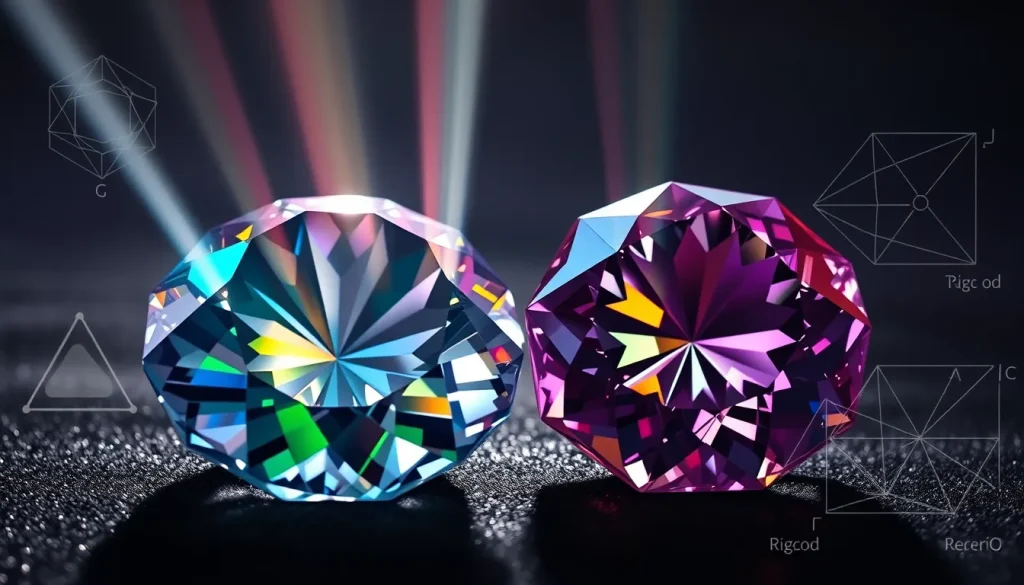
In the world of gemology, the visual appeal of a gemstone is often summarized by its “brilliance”—the amount of white light reflected back to the eye. While color and clarity are vital, the physics of how light interacts with a mineral’s internal structure is what creates that coveted sparkle. This phenomenon is primarily governed by the Refractive Index (RI).
Definition
The Refractive Index (RI) is a dimensionless number that describes how much light bends, or refracts, when it enters a gemstone from the air. Scientifically, it is the ratio of the speed of light in a vacuum to the speed of light in the specific medium. For example, light travels slower through a dense diamond than it does through a piece of quartz, resulting in a higher RI for the diamond.
Plain-English Explanation
Imagine light as a car driving on a straight highway (air). When that car hits a patch of thick mud (the gemstone), it slows down and changes direction. The “thicker” the optical mud, the more the light bends. When light bends sharply, it is more likely to be trapped inside the stone and bounce around before exiting through the top. This “trapping” and reflecting of light is what we perceive as brilliance. A high RI means the stone is more efficient at bending light, which generally leads to a more intense, sparkling appearance.
Example
To illustrate the impact of RI, consider the difference between Quartz and Diamond:
- Quartz: Has a relatively low RI of approximately 1.54. Light passes through it more easily, and unless the cut is perfect, much of the light “leaks” out the bottom.
- Diamond: Has a very high RI of 2.417. This high value allows light to reflect internally with great intensity, creating the signature “fire” and brilliance associated with the stone.
Another excellent example is Zircon (RI 1.92–1.98), which possesses a higher RI than many other precious stones, giving it a brilliance that often rivals that of a diamond, though with different dispersion characteristics.
Why It Matters
Understanding the refractive index is critical for several practical reasons in gemology and jewelry design:
1. Determining the Critical Angle
The RI determines the critical angle—the angle at which light is totally reflected back into the stone rather than escaping. Stones with a high RI have a wider window for total internal reflection, meaning they can be cut in more varied shapes while still maintaining high brilliance.
2. Gemstone Identification
The RI is one of the most reliable diagnostic tools for a gemologist. By using a refractometer, a professional can measure the RI to distinguish between two stones that look identical to the naked eye, such as a natural diamond and a cubic zirconia.
3. Cutting and Faceting
Lapidaries must adjust their cutting angles based on the stone’s RI. If a stone with a low RI is cut with the same angles as a diamond, it will appear “dead” or windowed (transparent in the center) because the light will pass straight through instead of reflecting back to the observer.
Expert Tip: Do not confuse Refractive Index with Dispersion. While RI governs the bending of light (brilliance), dispersion governs the splitting of white light into spectral colors (fire). A stone can have a high RI but low dispersion, or vice versa.
FAQ
Does a higher refractive index always mean a more expensive stone?
No. While high RI contributes to brilliance, value is determined by a combination of rarity, color, clarity, and demand. For example, Zircon has a high RI but is generally less valuable than a lower-RI sapphire.
Can a stone's refractive index change?
The RI is an intrinsic physical property of the mineral species and does not change. However, it can vary slightly based on the temperature of the stone or the wavelength of light passing through it.
What is the difference between brilliance and fire?
Brilliance is the return of white light to the eye (related to RI), while fire is the flashing of rainbow colors caused by the separation of light (related to dispersion).

Leave a Reply