
Short Answer
Direct Answer
Cleaning and storing rare collector’s minerals is the process of removing surface contaminants and implementing environmental controls to prevent chemical weathering, physical damage, or light-induced fading. Unlike jewelry, which is designed for wear, collector’s minerals are often fragile, chemically unstable, or water-soluble. The core objective is minimal intervention: only remove substances that actively threaten the specimen or severely obscure its aesthetic value, while ensuring the storage environment mimics the stability of a controlled museum archive.
Relevant Conditions
Different minerals react uniquely to their environment. Before any action is taken, a collector must identify the specimen’s sensitivity to the following conditions:
- Water Solubility: Halides (like Halite) and some sulfates will dissolve if cleaned with water.
- Photosensitivity: Certain minerals, such as Amethyst or Fluorite, can fade when exposed to prolonged UV light.
- Hygroscopy: Some minerals absorb moisture from the air, which can lead to surface clouding or structural collapse.
- Chemical Reactivity: Acidic or alkaline cleaners can etch the surface of carbonates (like Calcite) or react with sulfide minerals.
Professional Tip: Always assume a mineral is fragile until its hardness and solubility are verified. When in doubt, the safest course of action is to leave the specimen in its “as-found” state.
Recommended Steps
Phase 1: Non-Invasive Cleaning
The goal is to remove dust and loose debris without introducing liquids.
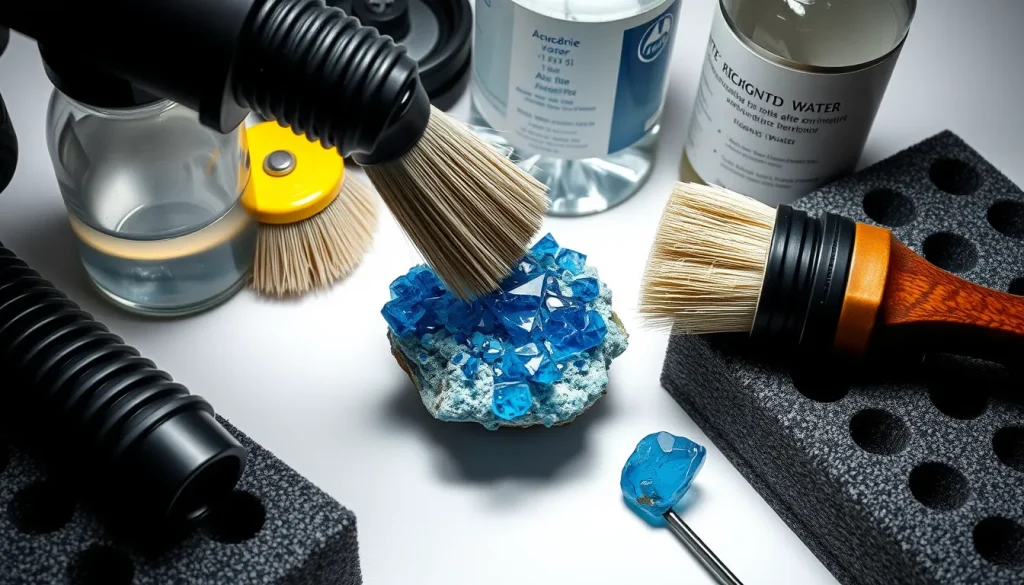
- Air Blasting: Use a manual rubber air blower (similar to those used for camera lenses) to remove loose dust from crevices.
- Soft Brushing: Use a high-quality, natural-hair artist’s brush or a soft makeup brush to gently sweep away particles.
- Vacuuming: Use a vacuum with a soft brush attachment, keeping the nozzle slightly away from the specimen to avoid accidental impact.
Phase 2: Aqueous and Chemical Cleaning
If surface grime or clay persists, proceed with extreme caution using the following hierarchy:
| Method | Applicability | Risk Level |
|---|---|---|
| Distilled Water | Most Silicates and Oxides | Low |
| Mild Soap Solution | Greasy residues on stable minerals | Medium |
| Ultrasonic Cleaning | Only for high-hardness, single-crystal gems | High (can shatter inclusions) |
| Chemical Acids | Removing iron stains (Professional only) | Very High |
Procedure for Water Cleaning: Use distilled water to avoid mineral deposits from tap water. Apply water using a spray bottle or a soft cloth. Rinse thoroughly and dry immediately using a gentle stream of air or by patting with a lint-free microfiber cloth.
Phase 3: Archival Storage
Proper storage prevents “cabinet disease” and physical degradation.
- Containers: Use acid-free cardboard boxes, archival-grade plastic (polypropylene), or glass cases. Avoid PVC plastics, which release corrosive gases.
- Padding: Use polyethylene foam or acid-free tissue paper to cushion specimens. Ensure the padding does not put pressure on fragile crystals.
- Environmental Control: Maintain a stable temperature and low humidity. Use silica gel packets in sealed containers for hygroscopic specimens.
- Lighting: Store photosensitive minerals in dark cabinets or use UV-filtering glass for display cases.
Exceptions
Certain mineral groups require specialized handling that deviates from standard protocols:
- Pyrites and Sulfides: Avoid high humidity, as these can react with moisture to produce sulfuric acid, leading to “pyrite decay.”
- Opals: These contain water; avoid airtight seals that cause dehydration or extreme heat that leads to “crazing” (cracking).
- Native Elements: Metals like native silver may tarnish; avoid sulfur-based cleaners and store in anti-tarnish strips.
When to Ask a Professional
Consult a professional conservator or senior gemologist in the following scenarios:
- High-Value Specimens: If the mineral is a museum-grade piece or has significant financial value.
- Complex Matrix: When the mineral is attached to a matrix that may react differently to cleaning agents than the crystal itself.
- Deep Staining: When iron or manganese stains are embedded in the crystal lattice and require targeted chemical etching.
- Structural Damage: If a specimen has fractured and requires archival-grade adhesives for stabilization.
FAQ
Can I use an ultrasonic cleaner on my mineral specimens?
Generally, no. Ultrasonic cleaners are designed for hard, faceted gemstones. For raw mineral specimens, the vibrations can cause fragile crystals to shatter or dislodge inclusions and matrix.
Is it safe to use soap and water on all minerals?
No. Water-soluble minerals like Halite will dissolve, and some minerals may react poorly to the chemicals in certain soaps. Always test a small, inconspicuous area first.
How should I protect my minerals from sunlight?
Store them in opaque cabinets or use display cases with UV-filtering glass. Avoid placing specimens on windowsills or under direct halogen lighting.
Leave a Reply