
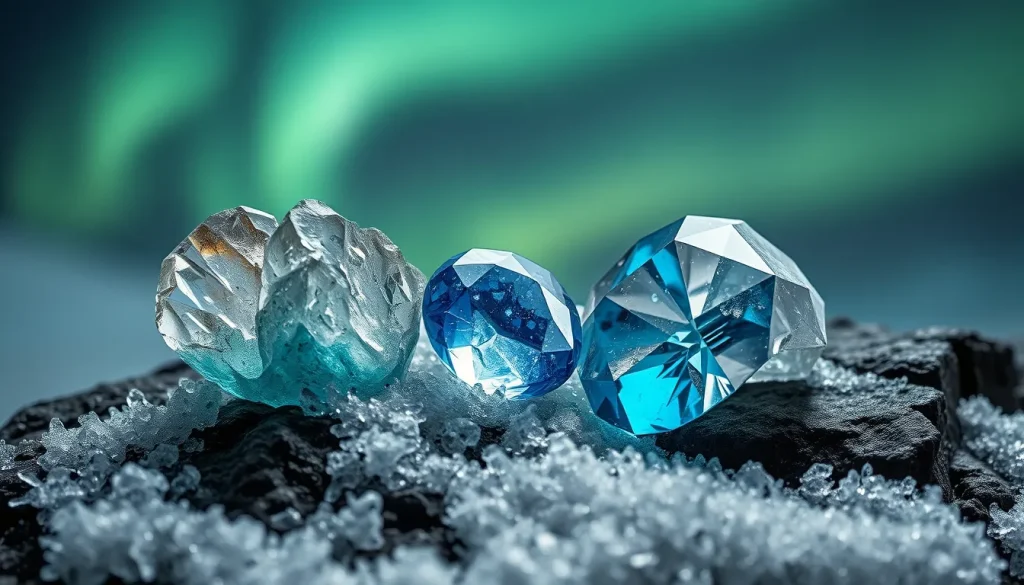
Short Answer
The Arctic regions of Greenland, Canada, and Russia are more than just frozen landscapes; they are geological treasure troves. The extreme tectonic history and unique chemical environments of these northern territories have produced minerals that are found nowhere else on Earth, or in qualities that are globally prized. For the gemologist, these regions offer a fascinating study in mineral stability and rare element concentration.
What Is an Arctic Gemstone?
While “Arctic gemstone” is not a formal mineralogical classification, it refers to gemstones and rare minerals extracted from the polar circles and sub-arctic regions. These minerals often form in ancient cratons—the oldest, most stable parts of the continental lithosphere—or through rare hydrothermal processes in volcanic belts. The scarcity of these stones is often compounded by the extreme difficulty of extraction in permafrost environments.
Varieties and Related Materials
The Arctic regions are characterized by several distinct mineral groups, ranging from industrial-grade crystals to high-end jewelry stones.
Greenland’s Rare Finds
Greenland is world-renowned for Cryolite, a rare fluoride mineral that was once found in massive deposits at Ivittuut. While primarily industrial, its crystalline form is a collector’s prize. Additionally, the region produces high-quality Fluorite and rare Aegirine.
Canada’s Northern Wealth
Canada’s Arctic territories, particularly the Northwest Territories, are famous for Diamond deposits. These diamonds are often characterized by high clarity and a wide range of colors. Canada also produces significant quantities of Amethyst and Citrine in its northern shield regions.
Russia’s Polar Minerals
Russia’s Arctic regions, including the Kola Peninsula, are legendary for Apatite and Epicene minerals. The region is also a source of rare Beryl varieties and unique Phenakite, a rare beryllium silicate highly prized by collectors for its diamond-like brilliance.
Identification and Look-Alikes
Identifying Arctic minerals requires precision, as some rare polar species can be mistaken for more common gemstones.
- Phenakite vs. Diamond: Phenakite from the Russian Arctic can mimic the luster and hardness of diamond but can be distinguished by its refractive index and lack of octahedral cleavage.
- Cryolite vs. Halite: While both may appear white or colorless, Cryolite is significantly denser and has a distinct chemical reaction to acids.
- Arctic Apatite vs. Beryl: Both can appear in vibrant blues or greens, but Apatite is softer (Mohs 5) compared to Beryl (Mohs 7.5-8).
Quality and Value Factors
The value of Arctic gemstones is driven by three primary factors: geological rarity, crystal size, and provenance.
| Gemstone | Primary Value Driver | Typical Color Range |
|---|---|---|
| Arctic Diamond | Clarity and Colorless Grade | Colorless to Light Yellow |
| Phenakite | Transparency and Size | Colorless to Pale Yellow |
| Cryolite | Crystalline Structure | White to Colorless |
| Apatite | Saturation of Color | Neon Blue to Deep Green |
“The true value of Arctic minerals often lies in their scientific significance. A specimen of cryolite from Greenland is not just a stone; it is a geological record of a chemical environment that exists almost nowhere else in the crust.”
Jewelry Suitability and Care
Due to the rarity and often lower hardness of some Arctic minerals, they require specific care when used in jewelry.
- Hardness Considerations: Apatite and Cryolite are too soft for rings; they are best suited for pendants or collector’s specimens.
- Cleaning: Avoid ultrasonic cleaners for polar minerals with inclusions, as extreme temperature shifts can cause internal fractures.
- Setting: Bezel settings are recommended for softer Arctic stones to protect the edges from chipping.
FAQ
Are Arctic gemstones more valuable because of the climate?
Not necessarily because of the climate, but because the geological conditions in these regions are rare, and the cost of extraction in frozen terrain increases the market value.
Can I wear Apatite from the Arctic in a ring?
It is not recommended. With a Mohs hardness of 5, it is prone to scratching and wear. A pendant or earring is a safer choice.
What makes Canadian diamonds different?
Canadian diamonds are often praised for their ethical sourcing and high clarity, though chemically they are identical to diamonds from other regions.
Leave a Reply