
Short Answer
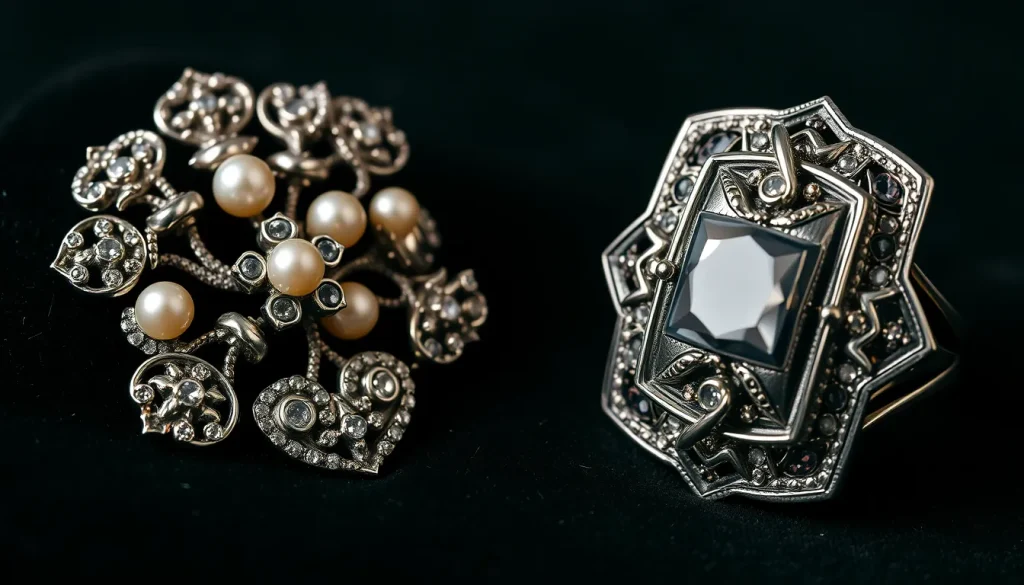
Marcasite jewelry occupies a unique niche in the world of antique gemstones. While technically a polymorph of iron pyrite, the term “marcasite” has been used commercially for centuries to describe the glittering, metallic facets used to mimic the brilliance of diamonds. Its journey through the 19th and early 20th centuries reflects the shifting social mores and aesthetic preferences of the Western world.
Documented Context
Marcasite is a sulfide mineral that provides a distinct metallic luster. In the context of jewelry, it is rarely the true mineral marcasite (which is unstable and degrades over time) but is almost always pyrite, cut into small, faceted stones. Its primary appeal was its ability to provide a “diamond-like” sparkle at a fraction of the cost, making it an essential material for the emerging middle class during the Industrial Revolution.
Place and Period
The prominence of marcasite jewelry is primarily centered in European jewelry hubs, most notably London, Paris, and later, the United States. Two distinct periods define its peak popularity:
- The Victorian Era (1837–1901): Characterized by romanticism, sentimentality, and a fascination with nature. Marcasite was often paired with seed pearls, garnets, or jet.
- The Art Deco Era (1920–1939): Defined by the “Machine Age,” emphasizing symmetry, bold lines, and industrial progress. Marcasite was used to create high-contrast, architectural patterns, often set in silver or white gold.
Historical Uses
During the Victorian period, marcasite served several specific cultural functions. It was frequently used in mourning jewelry, where its dark metallic sheen complemented jet and black enamel, symbolizing grief and remembrance. Additionally, it was a favorite for “day jewelry,” providing an elegant look that was not considered overly ostentatious for afternoon social calls.
“The use of marcasite in the late 19th century allowed for an democratization of luxury, enabling women of various social standings to wear intricate, glittering adornments without the prohibitive cost of colorless diamonds.”
As the transition to Art Deco occurred, the use of marcasite shifted from sentimental to structural. It became a tool for creating the geometric mosaics typical of the 1920s. Jewelers used marcasite to fill large areas of a design, creating a shimmering backdrop for a central gemstone or a striking monochromatic effect in silver.
Later Interpretations
Following the Art Deco period, marcasite entered a phase of “costume jewelry” ubiquity. In the mid-20th century, it became a staple of affordable vintage-style accessories. While it lost its status as a high-fashion statement, it gained a reputation as a timeless classic, often associated with “antique charm” and feminine elegance.
Modern Associations
Today, marcasite is viewed primarily as a collectible vintage material. Modern enthusiasts value it for its understated brilliance and its connection to historical craftsmanship. In contemporary jewelry, it is often used in “revival” pieces that mimic the Art Deco aesthetic, though these lack the historical patina and hand-setting techniques of original antique pieces.
Source Limitations
Identifying original Victorian or Art Deco marcasite requires careful examination of the metal and the setting technique. Because pyrite is so common, many modern reproductions look similar to antiques. Historians and gemologists rely on hallmarks, the wear patterns of the metal (specifically sterling silver oxidation), and the specific geometry of the cuts to distinguish between a 1920s original and a 1980s revival piece.
FAQ
Is marcasite jewelry made of real diamonds?
No, marcasite is a metallic mineral (usually pyrite) that mimics the sparkle of diamonds but has a distinct brassy or silvery metallic luster.
How can I tell the difference between Victorian and Art Deco marcasite?
Victorian pieces tend to be organic, floral, and sentimental, whereas Art Deco pieces are characterized by symmetry, bold geometric shapes, and a more industrial look.
How should I clean antique marcasite jewelry?
Avoid liquid cleaners and ultrasonic cleaners, as moisture can cause pyrite to oxidize or degrade. Use a soft, dry cloth to gently wipe the surface.
Leave a Reply