
Short Answer
Definition
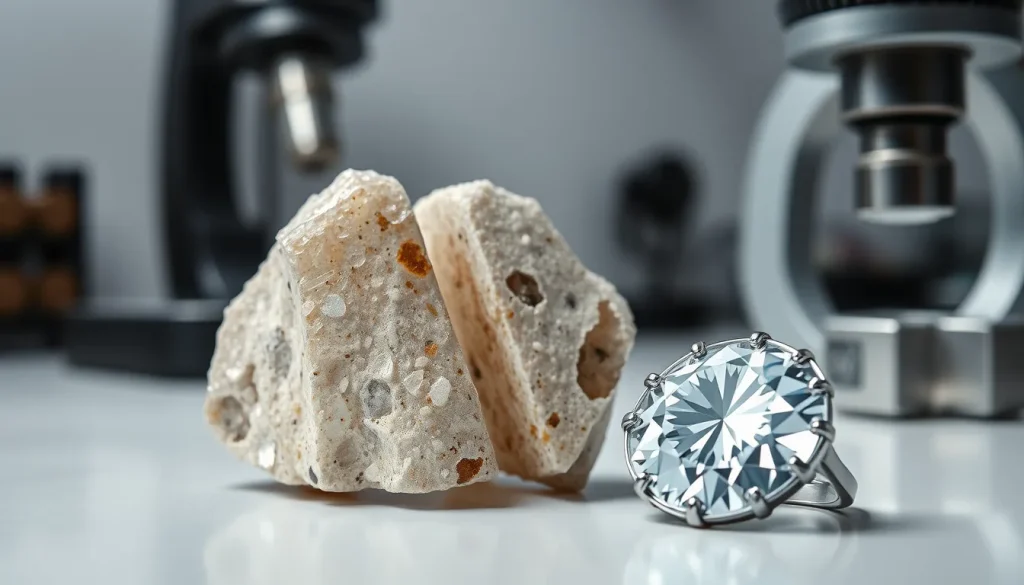
In gemology, cleavage refers to the tendency of a crystalline material to split along definite crystallographic structural planes. These planes are areas where the chemical bonds between atoms are relatively weak. When a gemstone is subjected to a sudden impact or stress, it may break along these specific planes, resulting in smooth, flat surfaces.
It is crucial to distinguish cleavage from fracture. While cleavage is a predictable break along a structural plane, fracture is an irregular or curved break that occurs when a gemstone lacks distinct planes of weakness.
Plain-English Explanation
Imagine a gemstone as a building made of LEGO bricks. In some stones, the bricks are snapped together tightly in every direction. In others, there are certain layers where the bricks are only lightly touching or held by weaker glue. If you hit the building with a hammer, the stone with “weak layers” will split perfectly straight along those lines. That is cleavage.
A common misconception is that hardness (resistance to scratching) equals toughness (resistance to breaking). For example, a diamond is the hardest natural substance on earth, meaning it is nearly impossible to scratch. However, diamonds have perfect cleavage in four directions. A sharp blow at the correct angle can split a diamond cleanly in half, despite its extreme hardness.
Example
The most illustrative examples of cleavage can be seen in the following gemstones:
- Diamond: Possesses perfect octahedral cleavage. This is why diamond cutters must be extremely precise; one wrong strike can shatter the stone.
- Fluorite: Exhibits perfect cleavage in four directions, making it very fragile and unsuitable for most jewelry.
- Calcite: Displays rhombohedral cleavage, splitting into smaller, identical slanted cubes.
- Emerald: Often has distinct cleavage and numerous internal inclusions (jardin), which combined make it significantly more prone to breaking than sapphire or ruby.
Expert Tip: When examining a gemstone under a loupe, look for internal “veils” or flat internal reflections. These can sometimes be evidence of incipient cleavage planes or healed fractures that indicate where the stone is most vulnerable.
Why It Matters
Understanding cleavage is essential for both the jeweler and the collector because it directly impacts jewelry durability and the choice of setting.
Impact on Setting Choice
Gemstones with strong cleavage require protective settings to prevent accidental impact. For instance:
- Bezel Settings: These wrap around the perimeter of the stone, providing a metal “buffer” that protects the edges from knocks.
- Prong Settings: While they allow more light, they leave the sides of the stone exposed. For stones with perfect cleavage, prongs should be designed to avoid putting uneven pressure on the crystal lattice.
Risk Assessment in Daily Wear
A stone with perfect cleavage is generally not recommended for high-impact jewelry, such as engagement rings worn during manual labor or athletic activities. A sudden knock against a hard surface (like a granite countertop) can trigger a cleavage break, leading to a catastrophic failure of the gem.
| Property | Cleavage | Fracture |
|---|---|---|
| Nature of Break | Smooth, flat, predictable planes | Irregular, jagged, or curved (conchoidal) |
| Cause | Weakness in atomic bonding | Random stress exceeding bond strength |
| Predictability | High (follows crystal system) | Low (random) |
FAQ
Can a hard gemstone still break easily?
Yes. Hardness only measures resistance to scratching. A gemstone can be very hard (like a diamond) but still have perfect cleavage, meaning it can split easily if hit at the correct angle.
How can I tell if my gemstone has cleavage?
If a stone has broken and the surface is perfectly flat and mirror-like, it is likely a cleavage break. If the break is jagged or curved, it is a fracture.
Which setting is safest for a stone with cleavage?
A bezel setting is generally the safest because it encases the girdle of the stone in metal, shielding the cleavage planes from direct impacts.
Leave a Reply