
Short Answer
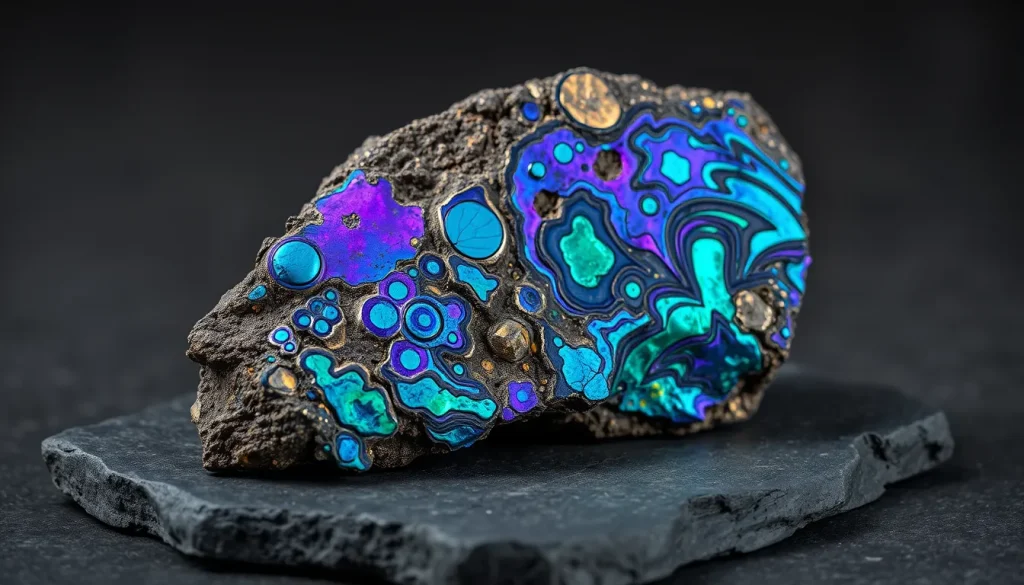
Bornite is a captivating copper iron sulfide mineral that is most famous for its striking iridescent tarnish. While not a gemstone in the traditional sense of being used for faceted jewelry, its vivid colors make it one of the most sought-after minerals for display and specimen collections. Often referred to as “Peacock Ore” due to the brilliant blues, purples, and greens that dance across its surface, Bornite provides a fascinating study in mineral oxidation.
What Is Bornite?
Bornite is a sulfide mineral with the chemical formula Cu₅FeS₄. In its fresh, unweathered state, Bornite actually appears as a metallic bronze-brown color. However, upon exposure to air and moisture, the mineral undergoes a chemical reaction—oxidation—which creates a thin film of secondary minerals on the surface. This film causes light interference, resulting in the vivid, multicolored iridescence that characterizes the “Peacock Ore” trade name.
From a crystallographic perspective, Bornite belongs to the cubic crystal system. It is typically found in hydrothermal veins and as a primary ore of copper, often associated with other sulfides like chalcopyrite and pyrite.
Practical Uses and Limitations
Due to its physical properties, Bornite has very specific applications and significant limitations when compared to precious gemstones:
- Specimen Collecting: The primary use of Bornite is as a mineral specimen. Its visual appeal makes it a staple in educational museums and private mineral galleries.
- Industrial Value: Historically and commercially, Bornite is valued as an ore for the extraction of copper.
- Jewelry Limitations: Bornite is rarely used in high-end jewelry because it is relatively soft and prone to further oxidation, which can lead to the degradation of the iridescent layer if not properly sealed.
Identification and Look-Alikes
Distinguishing Bornite from other iridescent minerals is crucial for collectors. The most common look-alike is Chalcopyrite, which can also exhibit a similar peacock-like tarnish. However, there are key differences:
| Feature | Bornite (Peacock Ore) | Chalcopyrite |
|---|---|---|
| Fresh Color | Bronze-brown | Brass-yellow |
| Tarnish | Deep purples and blues | More golden-greenish hues |
| Hardness | 2.5 – 3.5 | 3.5 – 4.0 |
Professional identification typically involves a streak test (Bornite leaves a grayish-black streak) or X-ray diffraction (XRD) for precise chemical confirmation.
Jewelry Suitability and Care
While Bornite is occasionally cut into cabochons or used in costume jewelry, it requires specialized care to maintain its luster. Because the iridescence is a result of surface oxidation, the “color” is essentially a fragile skin.
Expert Tip: To preserve the iridescence of a Bornite specimen or jewelry piece, avoid exposure to humidity and acidic cleaning agents. Many collectors apply a thin, clear mineral lacquer or acrylic spray to seal the surface and prevent further oxidation from dulling the colors.
Care Guidelines:
- Avoid water and ultrasonic cleaners.
- Clean only with a soft, dry microfiber cloth.
- Store in a cool, dry environment with low humidity.
Quality and Value Factors
The value of Bornite is determined primarily by its aesthetic presentation rather than its weight in carats. Key factors include:
- Color Intensity: Specimens with a full spectrum of vibrant purples, blues, and greens are more valuable than those with muted or monochromatic tones.
- Crystal Form: Well-defined crystals are prized over massive, amorphous chunks of ore.
- Luster: A high metallic sheen that enhances the iridescence increases the specimen’s desirability.
- Matrix: Specimens that occur naturally on an interesting host rock (matrix) are often more collectible.
FAQ
Is Peacock Ore the same as Bornite?
Yes, 'Peacock Ore' is the trade name for Bornite, specifically referring to the iridescent tarnish that develops on the mineral's surface.
Can Bornite be used in rings or necklaces?
While possible, it is not recommended for daily wear due to its low hardness and susceptibility to oxidation. It is best suited for earrings or pendants that are not subject to frequent impact or moisture.
Why does Bornite change color?
The color change is caused by oxidation. When the copper and iron in the mineral react with oxygen and moisture in the air, they form a thin oxide layer that refracts light into multiple colors.
Leave a Reply