
Short Answer
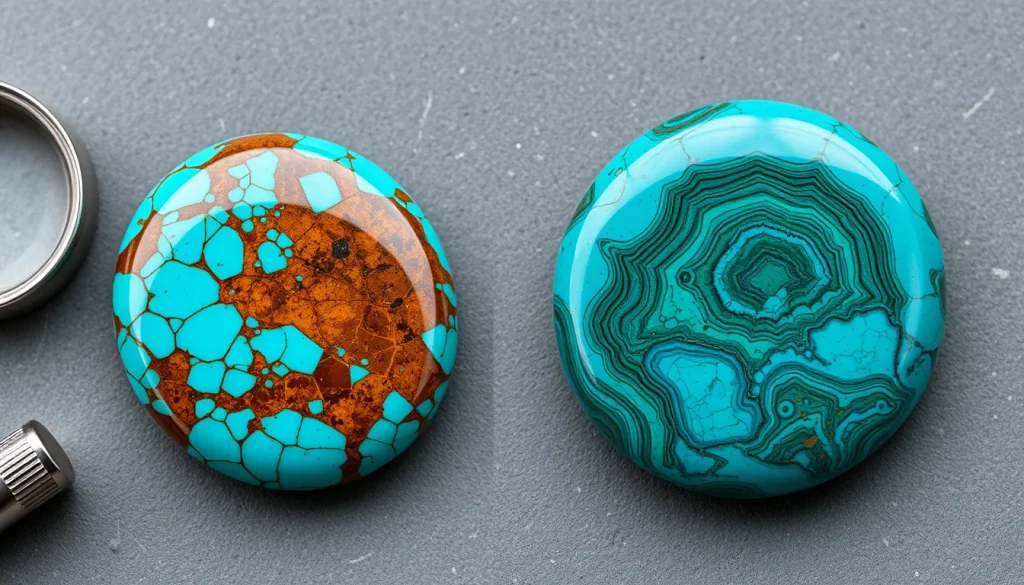
To the untrained eye, chrysocolla and turquoise appear nearly identical, both exhibiting the coveted shades of cyan, teal, and azure that have been prized by civilizations for millennia. However, from a gemological perspective, these two materials are fundamentally different in their chemical makeup, crystal structure, and durability. Understanding these distinctions is critical for collectors and jewelers to ensure proper valuation and care.
Comparison Table
| Feature | Turquoise | Chrysocolla |
|---|---|---|
| Chemical Formula | CuAl₆(PO₄)₄(OH)₈·4H₂O | (Cu,Al)₂H₂Si₂O₅(OH)₄ |
| Mineral Group | Phosphate | Silicate (Hydrated Copper Silicate) |
Mohs Hardness
| 5 to 6 | 2 to 4 |
| Luster | Waxy to Vitreous | Dull to Earthy |
| Transparency | Opaque | Opaque to Translucent |
| Common Matrix | Brown, Black, or Grey (Limonite) | Green, Brown, or White (Quartz/Azurite) |
Shared Features
The primary similarity between chrysocolla and turquoise is their coloration, which is derived from the presence of copper. Both gemstones occur in ranges from pale sky-blue to deep sea-green. Additionally, both are typically found as massive, non-crystalline aggregates and are often associated with the oxidation zones of copper ore deposits. Because of these visual similarities, chrysocolla is frequently marketed as “turquoise” or “copper turquoise” in lower-end jewelry markets, despite the lack of phosphate in its structure.
Important Differences
Chemical Composition
The most profound difference lies in their chemistry. Turquoise is a hydrated phosphate of copper and aluminum. Chrysocolla, conversely, is a hydrated copper silicate. This chemical divide affects how the stones react to heat and chemicals; for instance, turquoise is far more sensitive to acids and oils than many silicates.
Hardness and Durability
There is a significant gap in physical resilience. Turquoise is relatively hard (5–6 on the Mohs scale), making it suitable for rings and bracelets. Chrysocolla is significantly softer (2–4), often feeling “chalky” or “earthy.” Pure chrysocolla is too soft for most jewelry applications unless it is gem-silica (chrysocolla infused with quartz), which increases its hardness and luster.
Visual Markers and Matrix
While both can have a matrix, the patterns differ. Turquoise often features a distinct, spider-webbing matrix of limonite or iron oxides. Chrysocolla often displays a more “swirled” or “mottled” appearance, frequently blending into greens or showing inclusions of azurite (deep blue crystals).
Suitability by Use
When choosing between these two for jewelry or collecting, consider the following:
- Daily Wear: Turquoise is the superior choice for rings and earrings due to its higher Mohs hardness.
- Specimen Collecting: Chrysocolla is highly valued by mineral collectors for its vivid, saturated colors and its association with other copper minerals.
- Decorative Arts: Due to its softness, pure chrysocolla is best suited for carvings or as inlay in protected settings where it will not be subject to abrasion.
Identification Limits
Expert Tip: The most difficult identification occurs with “Gem Silica.” This is a natural mixture of chrysocolla and chalcedony. Because the quartz provides the hardness, Gem Silica can mimic the feel and durability of turquoise, making a streak test or professional spectroscopic analysis necessary for a definitive ID.
Visual inspection alone is often insufficient. A streak test can be helpful: turquoise typically leaves a pale blue or colorless streak, whereas chrysocolla may leave a more distinct blue-green streak, though this varies by purity.
Related Profiles
For those interested in copper-based minerals, it is recommended to study Azurite (the deep blue cousin of chrysocolla) and Malachite (the green carbonate mineral). These three often form a genetic family in the same geological environment.
FAQ
Can chrysocolla be used in jewelry?
Yes, but only if it is 'Gem Silica' (quartz-infused) or set in a protective bezel. Pure chrysocolla is too soft for daily wear.
Why is chrysocolla often sold as turquoise?
Due to their similar colors, some sellers mislabel chrysocolla to capitalize on the higher market demand and value of turquoise.
Is there a simple home test to tell them apart?
A hardness test is most effective. A steel nail (approx. 5.5) will generally scratch chrysocolla easily but may not scratch high-quality turquoise.
Leave a Reply