
Short Answer
Definition
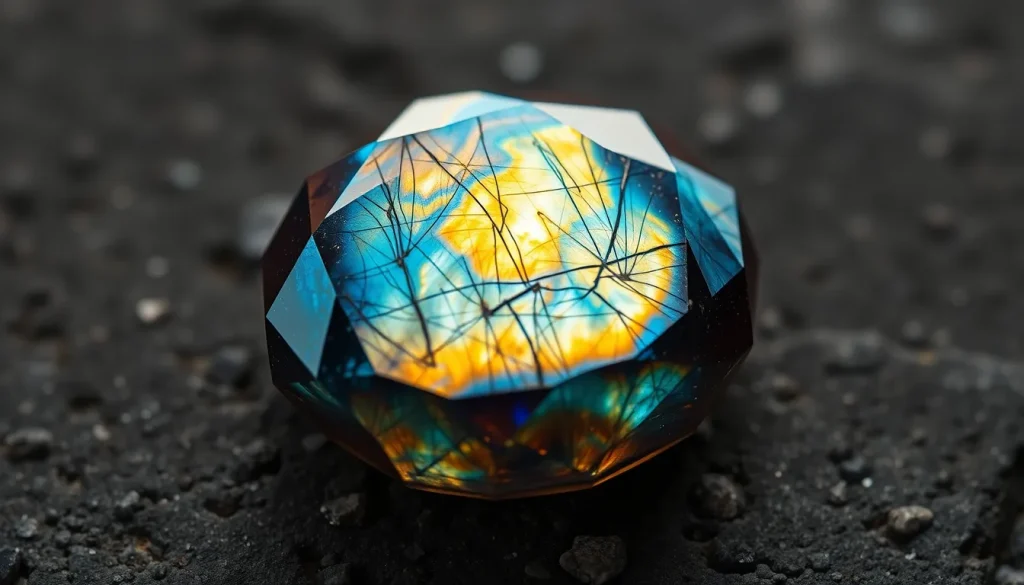
Labradorescence is an optical phenomenon known as a schiller effect, characterized by a metallic, iridescent play of colors that appears to shift as the gemstone is rotated. Unlike the fire in a diamond (dispersion) or the play-of-color in an opal (diffraction), labradorescence is caused by the reflection of light from microscopic layers within the mineral’s structure.
This effect is most famously observed in labradorite, but it also occurs in other members of the plagioclase feldspar group, such as spectrolite and moonstone (though moonstone’s effect is more specifically termed adularescence).
Plain-English Explanation
Imagine a gemstone that looks like a plain, dark grey rock until the light hits it at just the right angle. Suddenly, a flash of electric blue, neon green, or deep orange erupts from within the stone. This is labradorescence.
This happens because the mineral is not one solid block, but is actually made of thousands of incredibly thin, alternating layers of different feldspar compositions. When light enters the stone, it bounces off these layers. Some of the light waves cancel each other out, while others reinforce each other. This process, called interference, filters the light so that only specific colors reach your eye. As you tilt the stone, the path the light takes through these layers changes, which is why the colors seem to move or disappear entirely.

Example
The most prominent example of this effect is found in Labradorite. In a typical specimen, the base color of the stone is a medium-to-dark grey. When viewed from a specific angle, the observer may see a brilliant “flash” of blue. If the stone is rotated slightly, that blue may shift to a golden yellow or a vivid green. In rare specimens known as Spectrolite (found primarily in Finland), the labradorescence encompasses a full spectrum of colors, including reds and purples, which are much rarer than the standard blues.
Gemologist’s Tip: To best observe labradorescence, use a single, strong point source of light (like a flashlight or direct sunlight) rather than diffused overhead lighting. This enhances the contrast and makes the metallic flashes more pronounced.
Why It Matters
Understanding labradorescence is critical for several reasons in the world of gemology and mineralogy:
- Identification: It allows gemologists to distinguish labradorite from other grey minerals or synthetic imitations.
- Valuation: The intensity, size, and variety of the colors directly impact the market value. A stone with a full spectrum of colors is significantly more valuable than one showing only a faint blue shimmer.
- Material Science: The study of these lamellar structures helps scientists understand how minerals crystallize and cool over millions of years.
- Jewelry Design: Knowing that the effect is angle-dependent (directional) informs how a stone should be cut and set in a piece of jewelry to ensure the “flash” is visible to the wearer.
FAQ
Is labradorescence the same as iridescence?
While both involve a play of colors, iridescence is often caused by thin-film interference on the surface (like an oil slick). Labradorescence is a subsurface phenomenon caused by internal structural layers.
Why does my labradorite look grey from some angles?
Labradorescence is directional. The light must hit the internal lamellae at a specific angle to create interference; otherwise, you only see the natural base color of the mineral.
Can labradorescence be faked?
Some low-quality stones are coated with thin films to mimic the effect, but true labradorescence comes from within the stone. A professional gemologist can verify this using a microscope.
Leave a Reply