
Short Answer
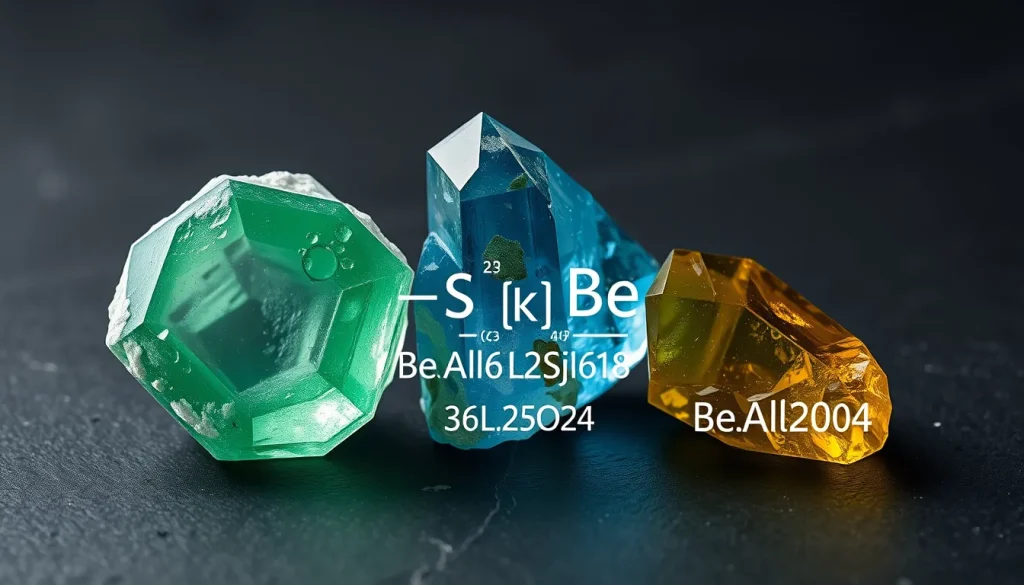
The world of gemology is often defined by chemical signatures, and few elements are as prestigious as Beryllium (Be). This rare alkaline earth metal serves as the foundation for some of the most valuable gemstones on Earth. While the general public views an emerald and a piece of chrysoberyl as entirely different entities, the gemologist sees them as cousins, linked by their shared dependence on beryllium to form their crystalline structures.
Comparison Table
| Property | Emerald (Beryl) | Aquamarine (Beryl) | Chrysoberyl |
|---|---|---|---|
| Chemical Formula | Be3Al2Si6O18 | Be3Al2Si6O18 | BeAl2O4 |
| Crystal System | Hexagonal | Hexagonal | Orthorhombic |
| Hardness (Mohs) | 7.5 – 8.0 | 7.5 – 8.0 | 8.5 |
| Primary Colorants | Chromium, Vanadium | Iron | Chromium, Iron |
| Refractive Index | 1.577 – 1.583 | 1.577 – 1.583 | 1.744 – 1.755 |
Shared Features
The primary bond between these gemstones is the presence of Beryllium. In both the Beryl group (emerald, aquamarine) and Chrysoberyl, beryllium acts as a critical structural component. Beyond chemistry, these minerals share a high degree of stability and durability, making them ideal for jewelry. Furthermore, they are often found in similar geological environments, specifically in pegmatites—coarse-grained igneous rocks where rare elements concentrate during the final stages of magma crystallization.
Important Differences
Despite their shared element, the structural divergence between Beryl and Chrysoberyl is significant:
- Chemical Composition: Beryl is a cyclosilicate, meaning it contains silicon (Si) and oxygen (O) arranged in rings. Chrysoberyl is an oxide mineral; it lacks the silica component entirely, resulting in a denser, harder crystal.
- Crystal Habit: Beryl forms hexagonal prisms, creating the classic six-sided columns seen in raw emeralds. Chrysoberyl forms orthorhombic crystals, which are more tabular or blocky.
- Optical Properties: Because Chrysoberyl is denser, it has a significantly higher refractive index than Beryl, giving it a more “brilliant” luster compared to the softer glow of aquamarine.
Suitability by Use
Choosing between these beryllium minerals depends on the desired application:
Expert Tip: For high-wear jewelry like engagement rings, Chrysoberyl (specifically the yellow variety) is superior due to its 8.5 Mohs hardness. Emeralds, while beautiful, are prone to “gardens” (internal fractures) and require more cautious handling.
- Emerald: Reserved for high-value statement pieces where deep green saturation is the priority.
- Aquamarine: Ideal for large-scale jewelry due to its typical clarity and availability in larger crystal sizes.
- Chrysoberyl: Best for collectors (Alexandrite) or those seeking a durable, high-luster yellow or green stone.
Identification Limits
To the untrained eye, a green chrysoberyl can be mistaken for an emerald. However, a professional gemologist uses specific tools to differentiate them:
- Refractometer: This is the gold standard. The high RI of chrysoberyl (1.74+) immediately separates it from beryl (1.57).
- Specific Gravity: Chrysoberyl is noticeably heavier (denser) than beryl of the same size.
- Pleochroism: Chrysoberyl often exhibits stronger pleochroism (color shifting when viewed from different angles) than beryl.
Related Profiles
To further understand these minerals, one should study the Beryl Group, which includes not only emerald and aquamarine but also the rare red beryl and golden beryl (heliodor). Additionally, exploring the Oxide Mineral Family provides deeper context on how chrysoberyl relates to other dense minerals like corundum.
FAQ
Is an emerald a type of aquamarine?
Technically, both are varieties of the mineral Beryl. Emerald is simply the green variety (colored by chromium/vanadium), while aquamarine is the blue/green variety (colored by iron).
Why is chrysoberyl harder than emerald?
Chrysoberyl is an oxide with a denser atomic structure and lacks the larger silicate rings found in beryl, leading to a higher Mohs hardness of 8.5.
Can you tell the difference between emerald and green chrysoberyl without tools?
It is very difficult. While chrysoberyl usually has a higher luster, a refractometer or specific gravity test is required for a definitive identification.
Leave a Reply