
Short Answer
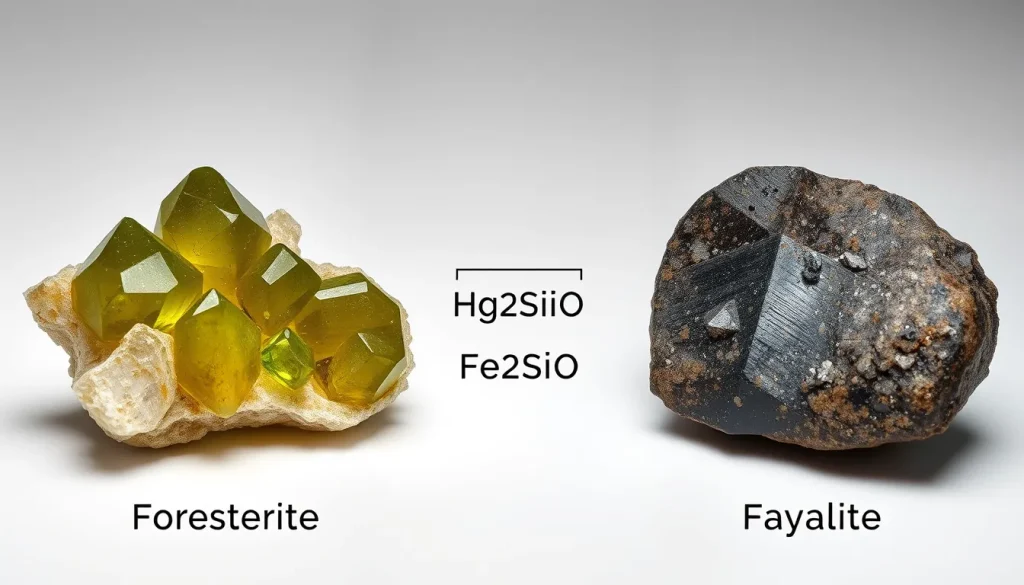
The olivine group represents one of the most significant mineral series in both geology and gemology. Rather than being a single mineral, olivine is a solid-solution series, meaning it consists of a range of minerals that share the same crystal structure but differ in their chemical composition. The two extreme ends of this spectrum are Forsterite and Fayalite.
Comparison Table
| Property | Forsterite | Fayalite |
|---|---|---|
| Chemical Formula | Mg2SiO4 | Fe2SiO4 |
| Dominant Element | Magnesium (Mg) | Iron (Fe) |
Typical Color
| Pale green to yellow-green | Brown, black, or dark green |
| Specific Gravity | ~3.22 – 3.27 | ~4.39 |
| Melting Point | Very High (~1890°C) | Lower (~1205°C) |
| Common Occurrence | Upper mantle, basaltic rocks | Iron-rich igneous rocks, metamorphic rocks |
Shared Features
Despite their chemical differences, Forsterite and Fayalite share several fundamental crystallographic and physical characteristics because they belong to the same mineral group:
- Crystal System: Both crystallize in the orthorhombic system.
- Structure: They both feature isolated silica tetrahedra linked by divalent metal cations (Mg or Fe).
- Hardness: Both generally fall within the 6.5 to 7 range on the Mohs scale.
- Luster: Both exhibit a vitreous (glassy) luster on fresh cleavage surfaces.
Important Differences
The primary driver of the differences between these two minerals is the substitution of magnesium for iron. This substitution affects almost every physical property of the resulting crystal.
Chemical Composition and Color
Forsterite is the magnesium-rich end-member. Its characteristic olive-green color is due to the presence of small amounts of iron substituting into the magnesium sites, though pure forsterite is colorless. Fayalite, the iron-rich end-member, is significantly darker, often appearing deep brown or black due to the high concentration of iron.
Density and Specific Gravity
Because iron is significantly heavier than magnesium, Fayalite is much denser than Forsterite. This difference in specific gravity is one of the most reliable ways for gemologists and geologists to distinguish between the two in a laboratory setting.
Thermal Stability
Forsterite has a significantly higher melting point than Fayalite. This makes Forsterite a primary constituent of the Earth’s upper mantle, as it can remain stable at extreme temperatures where Fayalite would melt.
Suitability by Use
The utility of these minerals varies based on their composition:
- Gemological Use: Only the magnesium-rich varieties (Forsterite) are typically used as gemstones. The trade name Peridot refers specifically to the gem-quality, magnesium-rich olivine. Fayalite is generally too dark and opaque for gemstone use.
- Industrial Use: Forsterite is highly valued in the ceramics industry for creating refractory materials (heat-resistant bricks) due to its extreme melting point.
- Scientific Use: Geologists use the ratio of Forsterite to Fayalite (the Fo% value) to determine the cooling history and origin of igneous rocks.
Identification Limits
Distinguishing between a magnesium-rich olivine and an iron-rich olivine cannot be done by visual inspection alone, especially when dealing with intermediate members of the series. While color provides a hint, the following limits apply:
- Visual Overlap: Some iron-rich olivines can appear green, mimicking forsterite.
- Equipment Needs: Precise identification requires a refractometer for refractive index measurement or, more accurately, an X-ray Fluorescence (XRF) spectrometer to determine the exact Mg:Fe ratio.
- Inclusions: Internal inclusions may vary, but they are rarely definitive enough to separate the two end-members without chemical analysis.
Related Profiles
To better understand the context of the olivine group, researchers should also examine the profiles of Peridot (the gem variety of forsterite) and Pyroxene, which often occurs alongside olivine in mafic igneous rocks.
FAQ
Is Peridot the same as Forsterite?
Yes, Peridot is the trade name for gem-quality olivine, which is almost always dominated by the Forsterite (magnesium) end-member.
Can a mineral be both Forsterite and Fayalite?
In nature, most olivines are intermediates. They contain both magnesium and iron; they are simply classified based on which element is more prevalent.
Why is Fayalite rarely used in jewelry?
Fayalite's high iron content typically results in a very dark, opaque appearance, lacking the transparency and bright green hue desired in gemstones.
Leave a Reply