
Short Answer
Carbonate minerals represent a diverse and significant group of minerals characterized by the presence of the carbonate ion (CO₃)²⁻. While some are primarily known as industrial materials, others are prized as collectors’ specimens or semi-precious gemstones due to their vibrant colors and unique crystal habits. Understanding the nuances of this group is essential for any serious gemologist or mineralogist.
What Is a Carbonate Mineral?
At a fundamental chemical level, carbonate minerals are salts of carbonic acid. They form when metal cations (such as calcium, magnesium, iron, or manganese) bond with the carbonate complex. The most ubiquitous member of this family is calcite, but the group encompasses a wide array of species with varying symmetries and compositions.
Most carbonates form in sedimentary environments, particularly in marine settings where biological organisms precipitate calcium carbonate to build shells and skeletons. However, they can also occur in hydrothermal veins and as metamorphic minerals (such as marble, which is recrystallized limestone).
Practical Uses and Limitations
Carbonate minerals serve a dual purpose in the modern world, spanning from massive industrial applications to specialized jewelry use.

Industrial and Architectural Applications
- Construction: Limestone and marble are primary materials for building and sculpture.
- Agriculture: Agricultural lime (calcite) is used to neutralize soil acidity.
- Manufacturing: Calcium carbonate is a key filler in paper, plastics, and paints.
Gemological and Ornamental Use
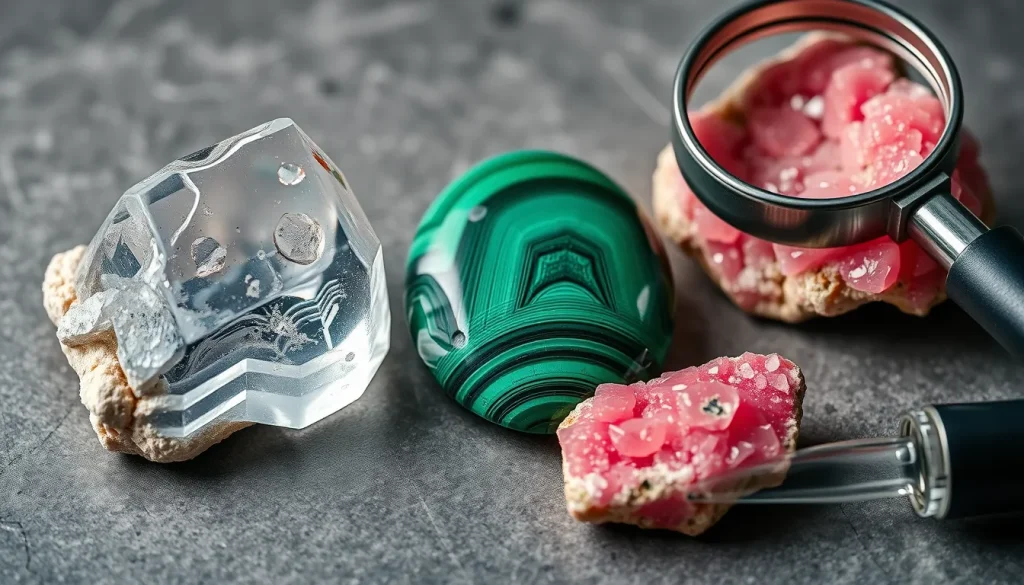
While most carbonates are too soft for daily-wear jewelry, certain varieties are highly collectible. Malachite and Azurite are prized for their deep greens and blues, while Rhodochrosite is valued for its striking pink hues. Due to their low Mohs hardness, these are typically used in cabochons, carvings, or as specimen pieces rather than faceted gemstones.
Varieties and Related Materials
The carbonate family is vast, but a few key minerals define the group’s characteristics:
| Mineral | Chemical Formula | Common Color | Distinguishing Feature |
|---|---|---|---|
| Calcite | CaCO₃ | Colorless, White, Yellow | Strong double refraction |
| Aragonite | CaCO₃ | White, Yellow, Grey | Orthorhombic crystal system |
| Malachite | Cu₂CO₃(OH)₂ | Bright Green | Botryoidal habit, banded patterns |
| Rhodochrosite | MnCO₃ | Pink to Red | Rhombohedral crystals |
| Siderite | FeCO₃ | Brown, Yellowish | High specific gravity |
Identification and Look-Alikes
Identifying carbonates requires a combination of physical tests and chemical reactions. The most diagnostic feature of the carbonate group is their reaction to acid.
Expert Tip: The “Acid Test” is the gold standard for carbonates. A drop of dilute hydrochloric acid (HCl) will cause a carbonate mineral to effervesce (bubble) as it releases carbon dioxide gas. Calcite reacts vigorously, while Siderite and Rhodochrosite may react more slowly or only when powdered.
Key Identification Markers
- Hardness: Most carbonates are relatively soft, typically ranging between 3 and 4 on the Mohs scale.
- Cleavage: Calcite exhibits perfect rhombohedral cleavage, meaning it breaks into slanted cubes.
- Optical Properties: Calcite is famous for its extreme birefringence, which creates a double image of any text viewed through a clear crystal.
Common Look-Alikes
Carbonates can often be confused with other minerals. For example, Malachite is sometimes mistaken for green chrysocolla or variscite, but its distinct banding and acid reaction separate it. Rhodochrosite can be confused with pink tourmaline or rhodonite; however, rhodonite is harder and does not effervesce in acid.
Jewelry Suitability and Care
Because of their chemical sensitivity and physical softness, carbonate minerals require specialized care.
- Avoid Acids: Never use acidic cleaners (like vinegar or lemon juice) on carbonate gemstones, as they will etch the surface and destroy the polish.
- Gentle Cleaning: Use only a soft, damp cloth or lukewarm soapy water. Avoid ultrasonic cleaners for porous varieties like Malachite.
- Storage: Store carbonates separately from harder gemstones (like diamonds or sapphires) to prevent scratching.
FAQ
Why does calcite bubble when acid is applied?
The acid reacts with the carbonate ion (CO₃)²⁻, breaking it down and releasing carbon dioxide (CO₂) gas in the form of bubbles.
Can carbonate minerals be used in rings?
They are generally not recommended for rings due to their low hardness (3-4 Mohs), making them prone to scratches and wear. They are better suited for pendants or earrings.
What is the difference between Calcite and Aragonite?
While both have the same chemical formula (CaCO₃), they are polymorphs, meaning they have different crystal structures: Calcite is trigonal, while Aragonite is orthorhombic.
Leave a Reply