
Short Answer
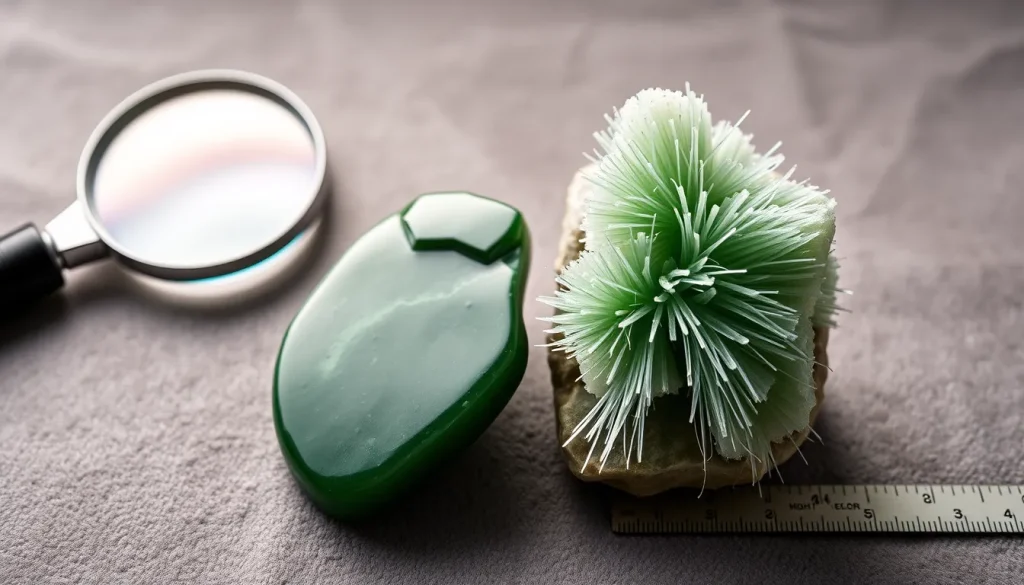
In the world of green gemstones, visual similarity often masks profound geological differences. Actinolite and jade—specifically nephrite jade—are frequently confused due to their shared color palette and occasionally similar luster. However, from a gemological perspective, they belong to different mineral groups and possess distinct physical properties that dictate their value and utility in jewelry.
Comparison Table
| Feature | Actinolite | Jade (Nephrite) | Jade (Jadeite) |
|---|---|---|---|
| Mineral Family | Amphibole | Amphibole (Tremolite-Noscapolite) | Pyroxene |
| Hardness (Mohs) | 5.0 – 6.0 | 6.0 – 6.5 | 6.5 – 7.0 |
| Structure | Fibrous to Acicular | Interlocking Microcrystalline | Granular/Polycrystalline |
| Transparency | Opaque to Translucent | Translucent to Opaque | Translucent to Transparent |
| Typical Luster | Vitreous to Silky | Greasy to Vitreous | Vitreous |
Shared Features
The primary commonality between actinolite and jade is their coloration. Both can exhibit a wide range of greens, from pale mint to deep forest green, often caused by the presence of iron or chromium. Furthermore, both materials are silicates, meaning they are composed of silicon and oxygen atoms combined with other elements.
In certain forms, such as Nephrite jade, the mineral is actually a member of the tremolite-actinolite series, which explains why the two can look nearly identical to the naked eye. Both are often carved into ornaments or used as cabochons in jewelry due to their saturated colors.
Important Differences
Mineralogical Composition
Actinolite is a double-chain silicate of calcium, magnesium, iron, and aluminum. While nephrite jade is technically a variety of actinolite/tremolite, “Jade” as a commercial term encompasses both nephrite and jadeite. Jadeite is a pyroxene, which is chemically and structurally distinct from the amphibole group to which actinolite belongs.
Structural Integrity and Toughness
The most critical difference lies in the microstructure. Actinolite typically forms in fibrous or needle-like crystals. In contrast, jade is renowned for its extraordinary toughness—not necessarily hardness, but resistance to fracturing. This is due to an interlocking, felt-like structure of crystals that prevents cracks from propagating through the stone.
Gemologist’s Tip: Never confuse hardness with toughness. While a diamond is the hardest, jade is one of the toughest minerals because its interlocking structure makes it incredibly difficult to shatter.
Luster and Optical Properties
Actinolite often displays a silky luster when the fibrous crystals reflect light. Jade, particularly nephrite, is famous for its “greasy” or waxy luster, which gives it a soft, glowing appearance when polished.
Suitability by Use
- Actinolite: Best suited for collector specimens, low-wear jewelry (like pendants), or decorative carvings. Its lower hardness makes it prone to scratching.
- Jade: Highly suitable for high-wear jewelry such as bangles and rings. Its extreme toughness allows it to withstand significant impact and daily wear.
Identification Limits
Distinguishing between a low-grade nephrite jade and a high-quality actinolite can be challenging without laboratory equipment. Visual inspection is often insufficient. Professionals rely on Refractive Index (RI) measurements and Specific Gravity (SG) tests to confirm the identity. For example, jadeite has a significantly higher specific gravity than actinolite.
Related Profiles
For those interested in green silicates, it is recommended to explore the profiles of Serpentine, which is often sold as “New Jade,” and Epidote, which shares similar color profiles and geological environments with actinolite.
FAQ
Can actinolite be sold as jade?
Yes, unfortunately, low-grade actinolite or serpentine is sometimes marketed as 'jade' to unsuspecting buyers. Always request a gemological report for expensive pieces.
Is jade harder than actinolite?
Yes, both nephrite and jadeite are harder on the Mohs scale than actinolite, and significantly tougher due to their interlocking crystal structure.
How can I tell them apart at home?
While difficult, look at the luster. Actinolite often looks 'silky' or fibrous, whereas jade has a more 'greasy' or waxy glow when polished.
Leave a Reply